
Philadelphia’s manufacturing history has played a central role in shaping the nation’s innovation and strength. In the early years of the United States, the city became a leading industrial center, producing textiles, machinery, and iron goods that supported economic growth and infrastructure. During the Industrial Revolution, companies like Baldwin Locomotive Works helped power expansion through large-scale production and technological advancement.
Forging a Nation: Philadelphia’s Role in Industrial Growth
Timeline
In the 20th century, Philadelphia manufacturers supported wartime efforts and strengthened America’s global industrial position. Today, the region continues this legacy through advanced manufacturing, biotechnology, and robotics, demonstrating how Philadelphia’s ability to adapt and innovate has remained a driving force in American industry.
1775
The first machine in America for spinning multiple threads of cotton or wool
The April 1775 issue of Pennsylvania Magazine featured a drawing of a “New invented machine for spinning of wool or cotton.” The magazine noted that the device was made in Philadelphia by Christopher Tully, “who first Made and Introduced this Machine into this Country.” It was capable of spinning 24 threads of cotton or wool at one time.
The United Company of Philadelphia for Promoting American Manufactures, established that same year, used Tully’s machine in a factory it set up at Ninth and Market Streets. The United Company’s initiatives were part of an effort by colonial leaders to spur domestic manufacturing in order to compete militarily and economically with the mother country, England, with whom the American colonies were about to go to war.
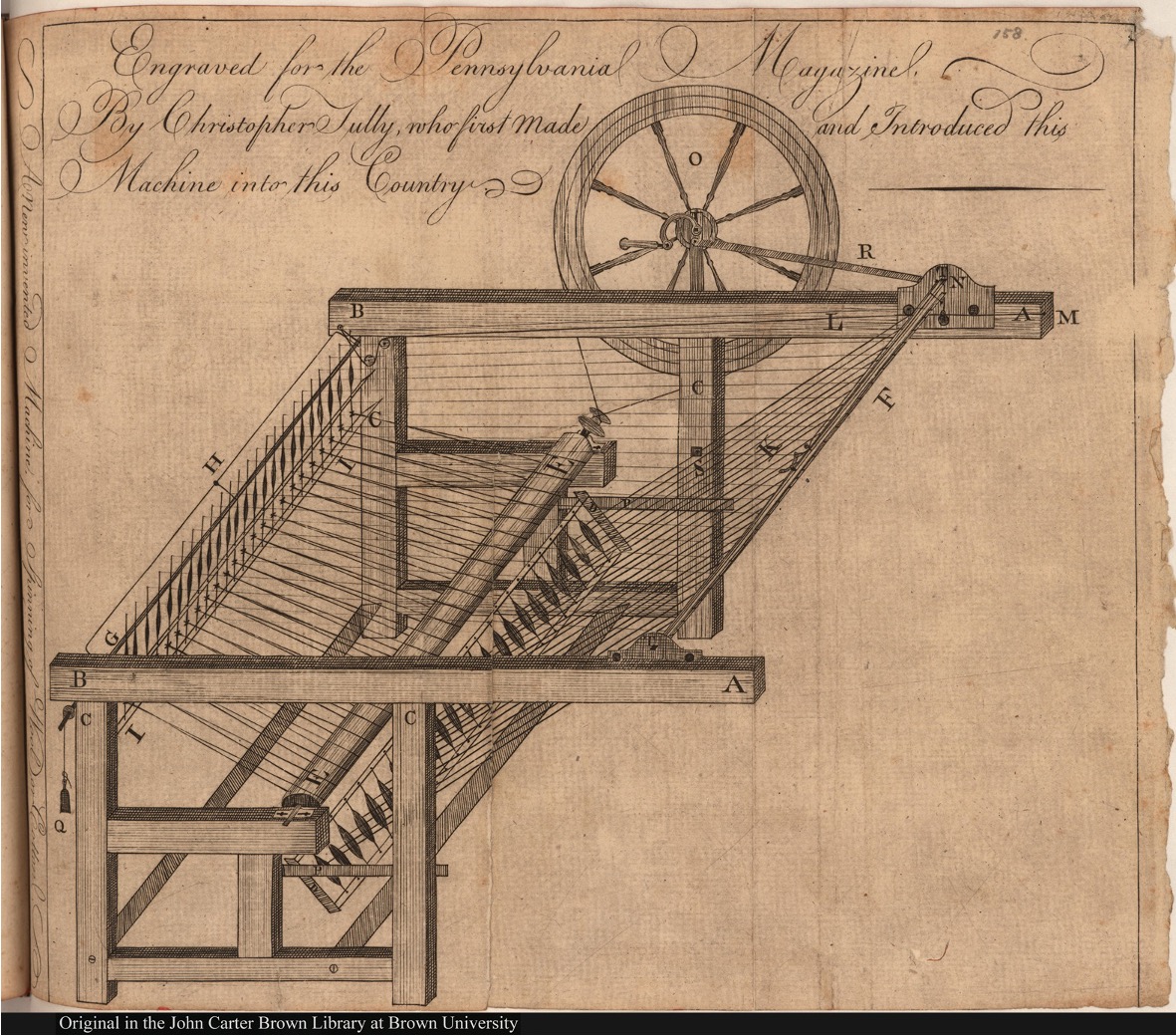
Drawing of Christopher Tully’s “New invented machine for spinning of wool or cotton,” published in the April 1775 issue of Pennsylvania Magazine.
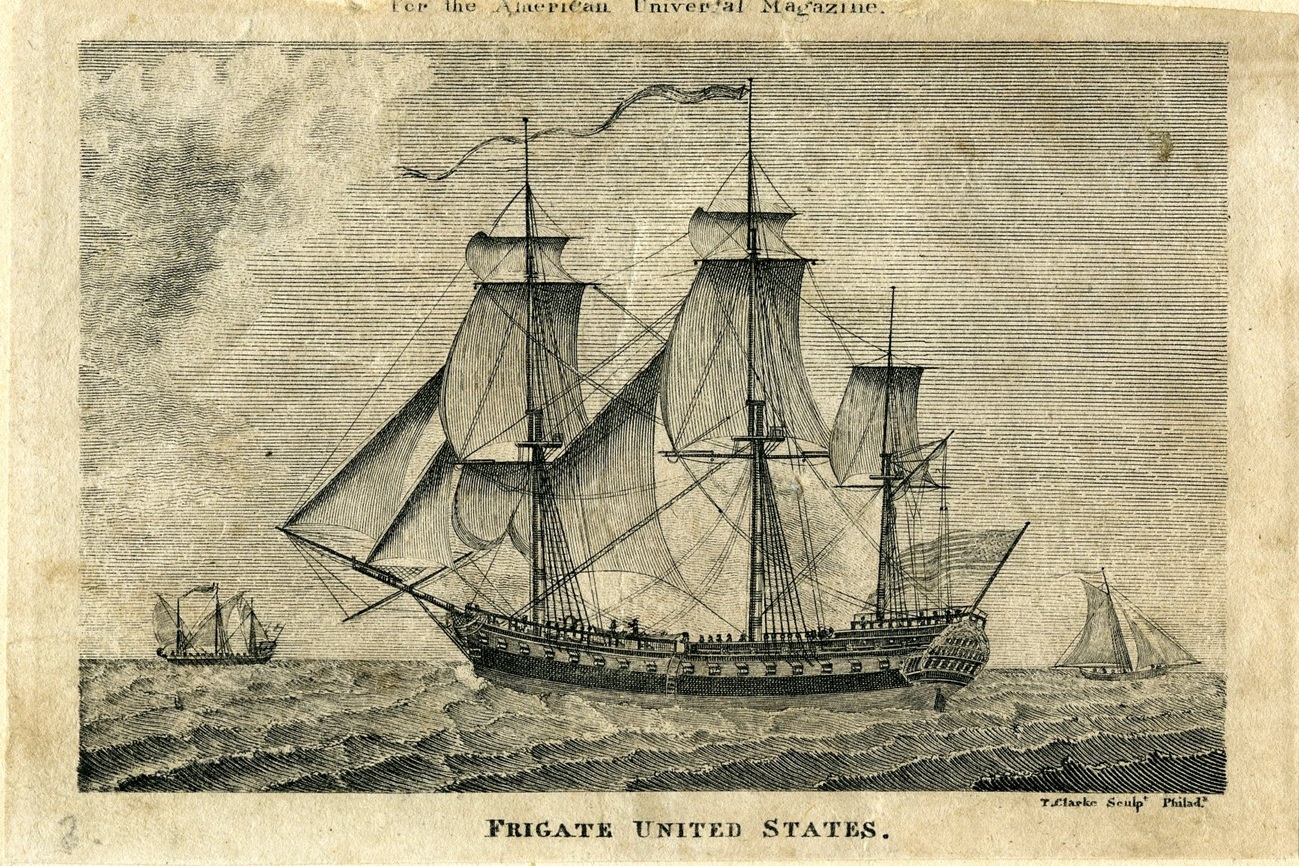
The USS United States, designed and built by Joshua Humphreys and launched from his Philadelphia shipyard in May 1797. J. Welles Henderson Collection, US Seaport Museum, Philadelphia.
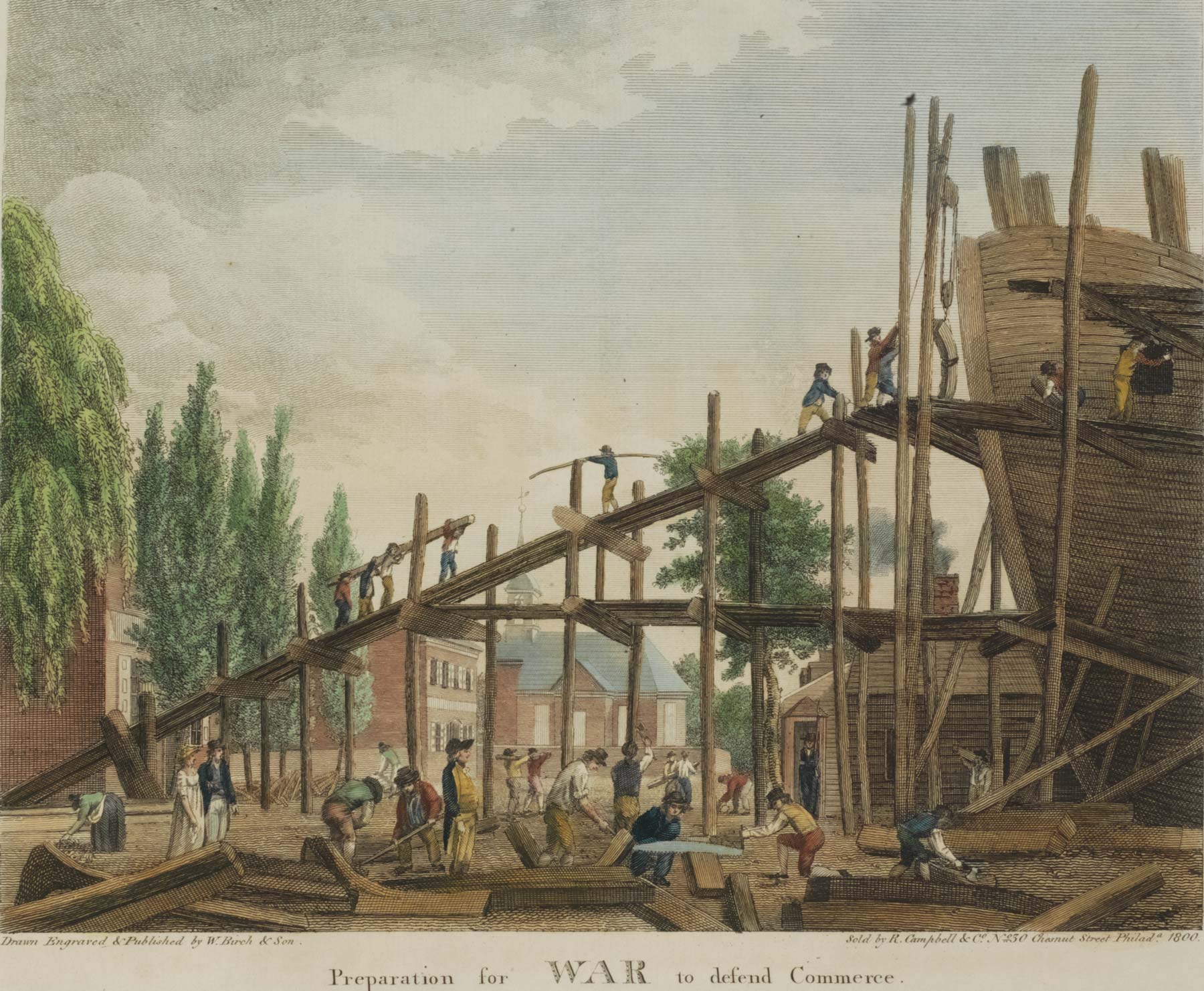
This illustration, published in 1800 in Birch’s Views of Philadelphia, depicts the building of the USS Philadelphia at Joshua Humphrey’s shipyard in 1797-1798. Library of Congress Rare Book and Special Collections Division
1797
Joshua Humphreys’ shipyard launches the USS United States
Philadelphia ship designer and builder Joshua Humphreys gained experience designing vessels during the Revolutionary War and in the years following the War operated a shipyard on the Delaware River in Southwark, at present-day Washington Avenue and Columbus Boulevard.
In 1797, the US Navy commissioned Humphreys to design six new frigates. The first of these, the USS United States, was launched from Humphreys’ Philadelphia shipyard in May 1797. Humphreys went on to build a number of important ships at his yard, including the USS Philadelphia, launched in 1799. Two years later, the US Navy purchased Humphreys’ shipyard for the nation’s first Navy Yard.
1801
Oliver Evans invents high-pressure steam engine
Oliver Evans, a brilliant Philadelphia engineer, inventor, and entrepreneur, built a new high-pressure steam engine in 1801 and received a patent for it in 1804. In 1806 he established the Mars Works at 9th and Vine Streets, one of the first steam engine manufacturing plants in the United States.
While steam engines had been in use for many years, Evans’s engine was much more powerful and efficient. This and other Evans inventions would help fuel the First Industrial Revolution of the early nineteenth century.
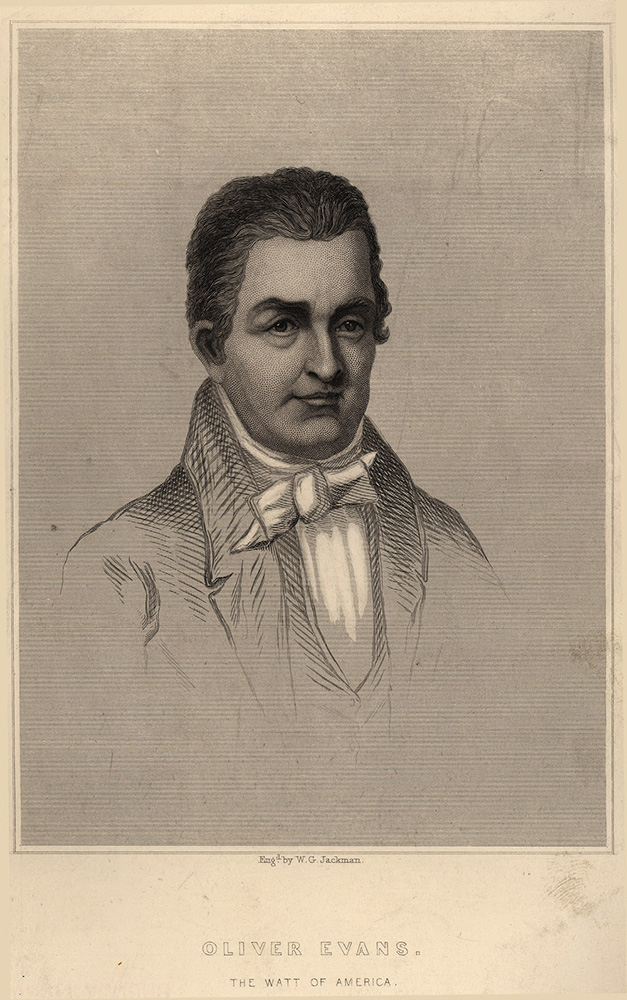
c. 1790 engraving of Oliver Evans. Dibner Library of History & Technology, Smithsonian Libraries.
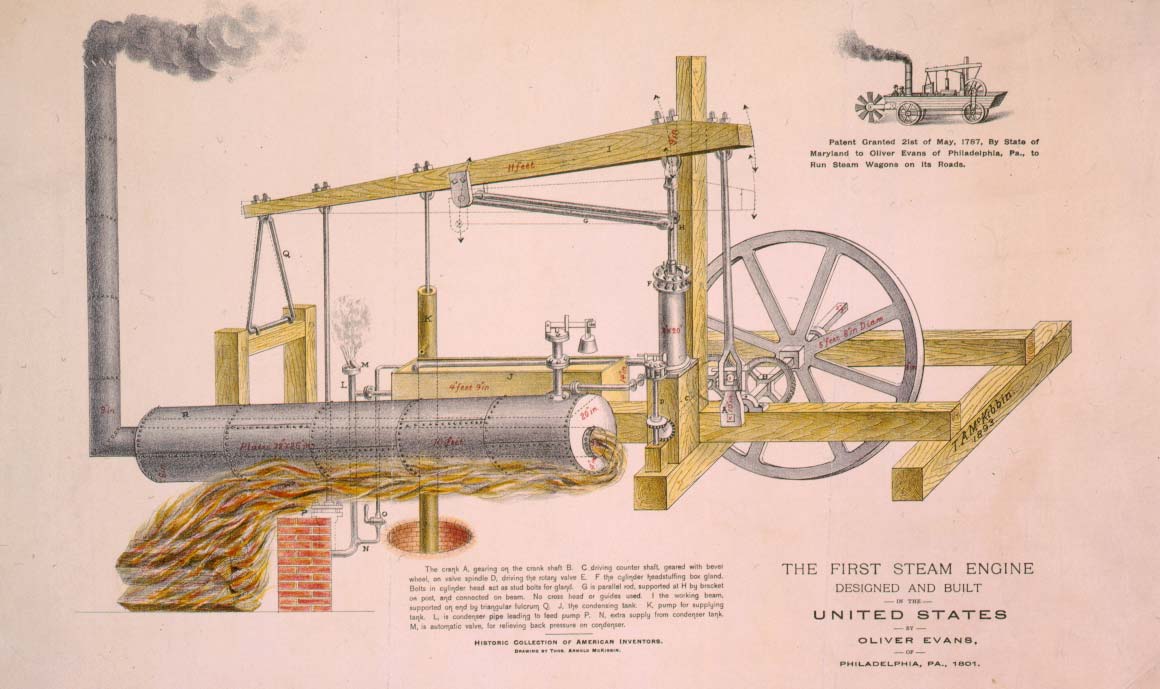
Illustration of “The First Steam Engine Designed and Built in the United States by Oliver Evans of Philadelphia, PA, 1801.” Prints & Photographs Division, Library of Congress.
1820
Lehigh Coal and Navigation Company founded
Engineer and inventor Josiah White and his partner Erskine Hazard established the Lehigh Coal and Navigation Company to bring large amounts of anthracite coal from Northeastern Pennsylvania to Philadelphia. In the 1810s, workers at White and Hazard’s Philadelphia factory discovered that anthracite coal burned much longer and more intensely than the more commonly used bituminous coal, providing an exceptionally powerful energy source for manufacturing.
With the discovery of large deposits of anthracite in the Lehigh Valley, White and Hazard established their navigation company to bring massive amounts of the high-energy coal to power Philadelphia’s many factories and mills. With anthracite fueling steam engines throughout the city, Philadelphia became a key center of the First Industrial Revolution in the early nineteenth century.
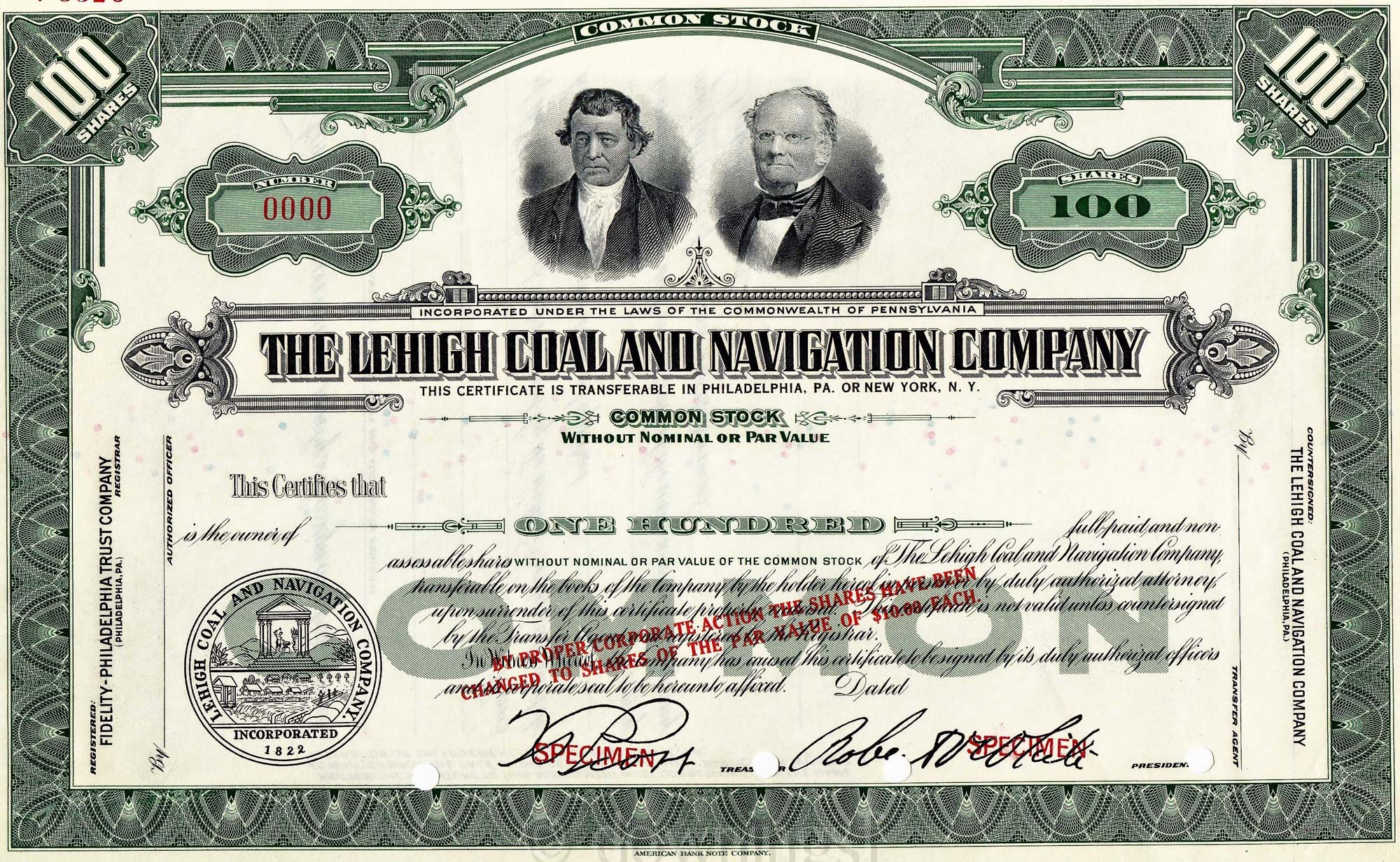
Stock certificate for The Lehigh Coal and Navigation Company, with images of company founders Josiah White (left) and Erksine Hazard. Wikipedia Commons.
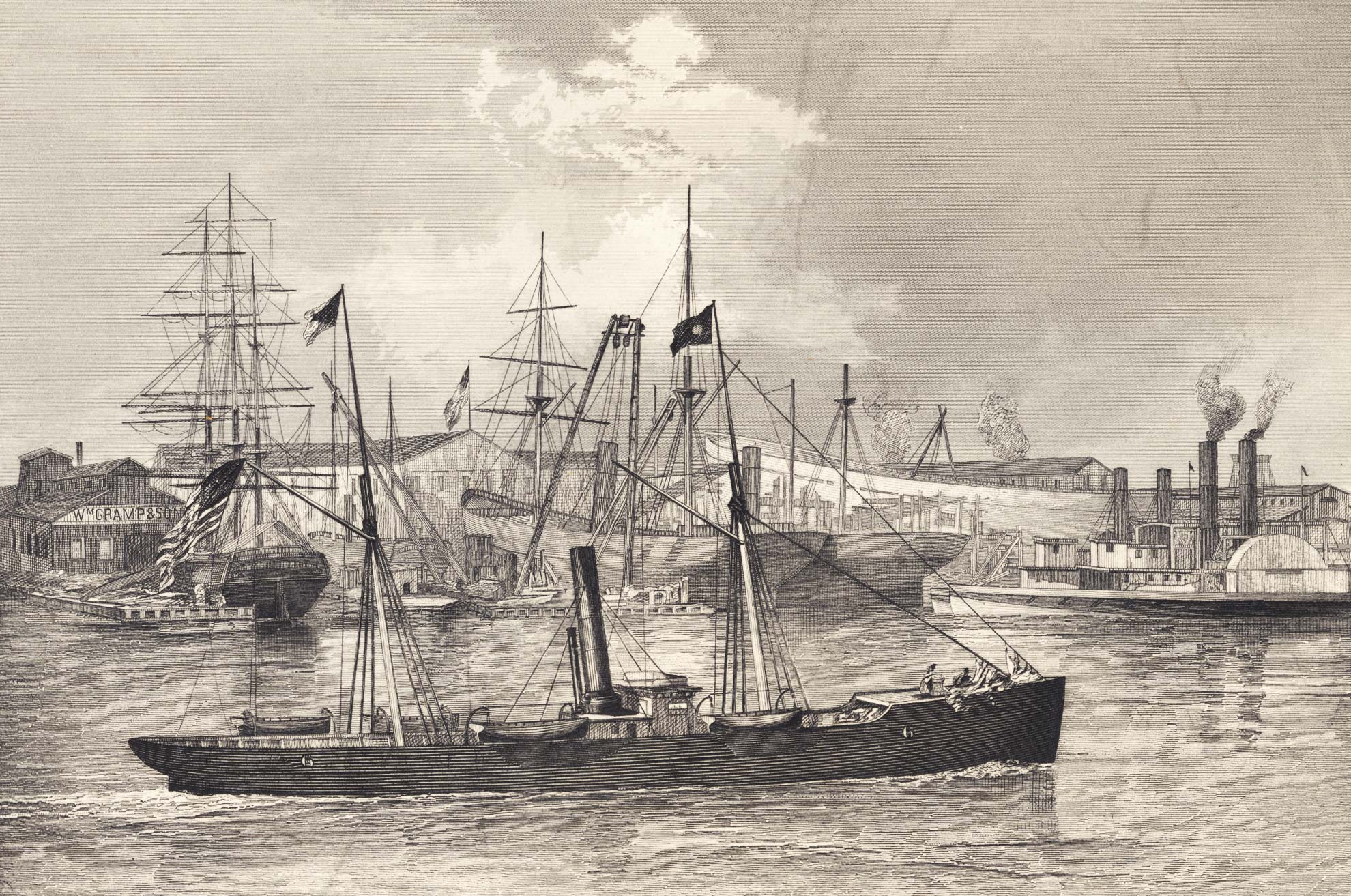
Cramp shipyard, 19th-century view. Print Collection, Historical Society of Pennsylvania.
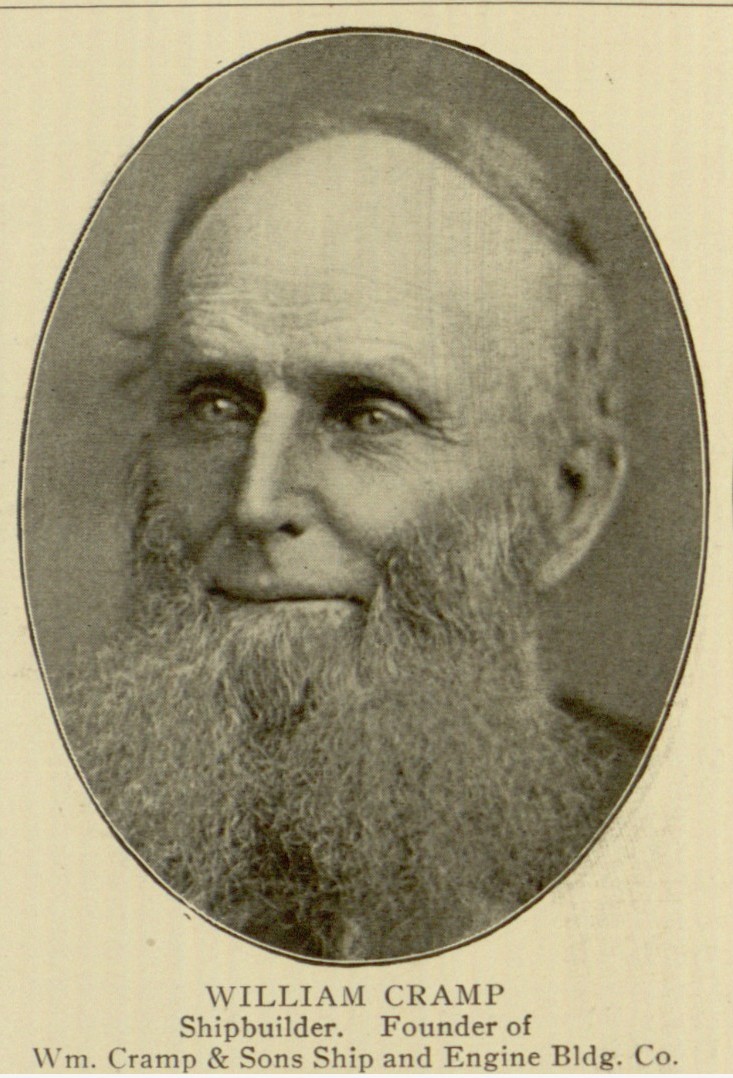
William Cramp, founder of Cramp Shipyard. Image published in Philadelphia and Notable Philadelphians, by Moses King, 1902.
1830
Cramp Shipyard established
Born in the Kensington neighborhood of Philadelphia in 1807, William Cramp apprenticed with a local ship builder before opening his own shipyard in 1830. Securing contracts for both commercial and military vessels, his company grew and in the late 1840s moved to a large riverfront site in Lower Kensington.
Beginning in the age of wooden ships and cloth sails, Cramp was one of the few shipyards to successfully transition to iron-clad, steam-driven vessels in the mid-19th century. The company would occupy its Lower Kensington site for over a century and grow into one of the nation’s largest shipyards. It closed in 1927 but re-opened in 1941 to build some 40 military vessels for World War II before closing permanently after the war.
1832
Matthias Baldwin’s new locomotive put into use on Philadelphia’s first railroad line
On November 24, 1832, “Old Ironsides” a new locomotive engine built by Matthias Baldwin, was put in service to power the Philadelphia, Germantown, & Norristown Railroad. Opened in June of that year, the Philadelphia, Germantown, & Norristown line was the city’s first railroad and was drawn by horses until Baldwin’s new steam-powered locomotive was put into use.
An innovative craftsman, Baldwin had begun building steam engines in the 1820s and in 1835 established the Baldwin Locomotive Works, which would eventually grow into Philadelphia’s largest private company and the world’s largest locomotive manufacturer. The rise of railroads in the 1830s and 1840s would transform the city’s manufacturing landscape.
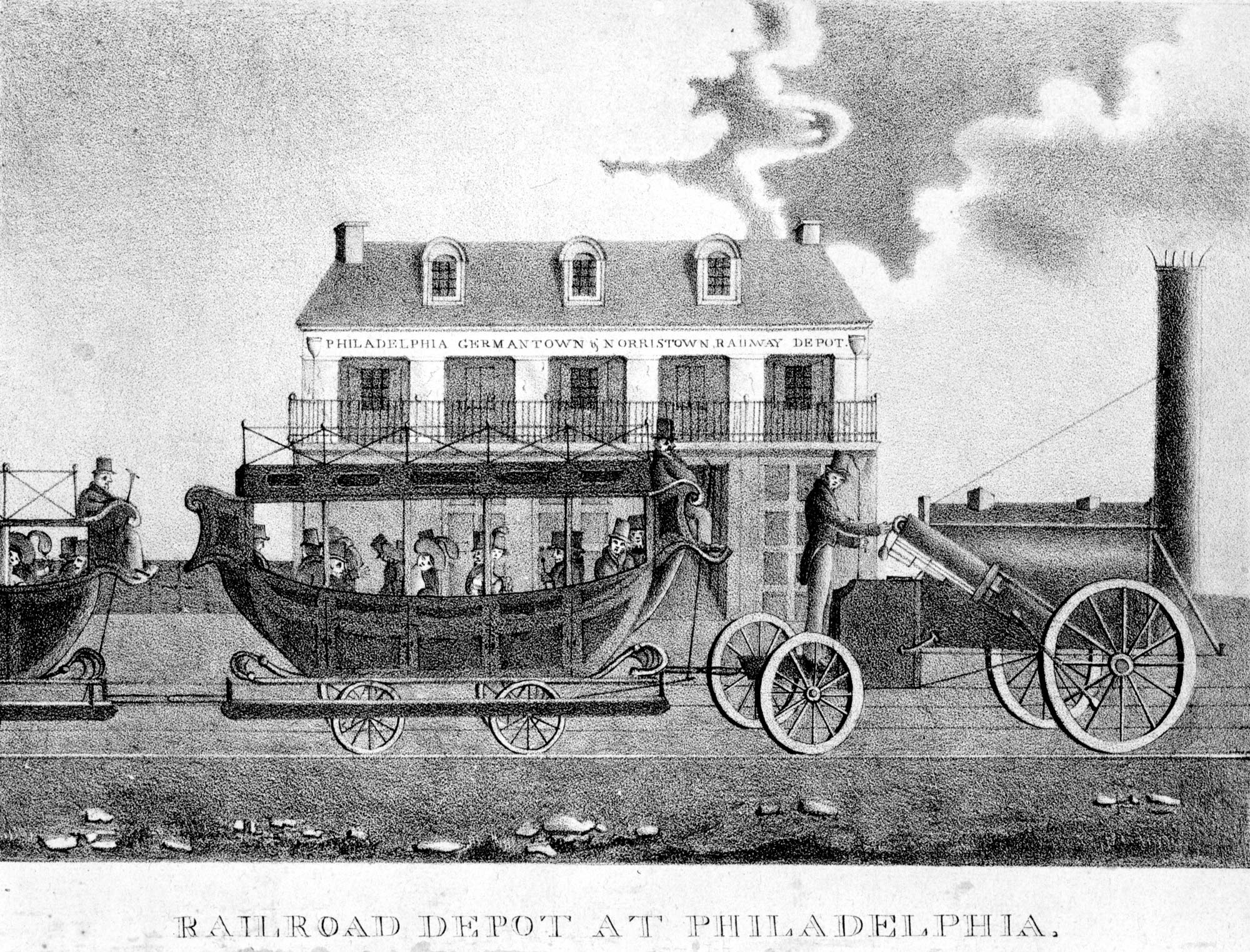
1832 illustration showing Matthias Baldwin’s new locomotive “Old Ironsides” powering passenger cars of the Philadelphia, Germantown, & Norristown Railroad, Philadelphia’s first railroad line. Print Department, Library Company of Philadelphia.
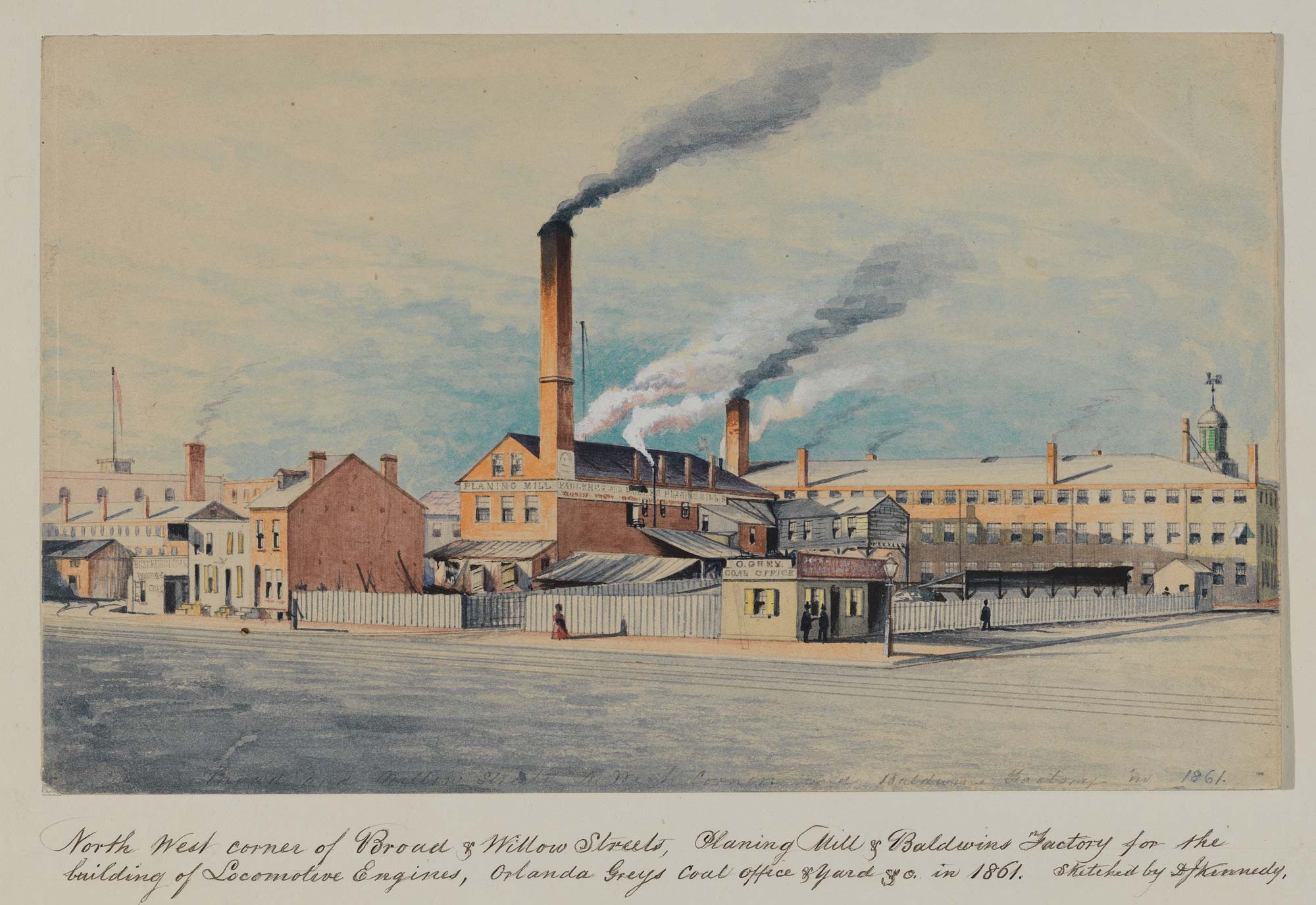
1861 painting of the corner of Broad and Willow Streets, showing the Baldwin Locomotive Works and other industries. David Kennedy Watercolor Collection, Historical Society of Pennsylvania.
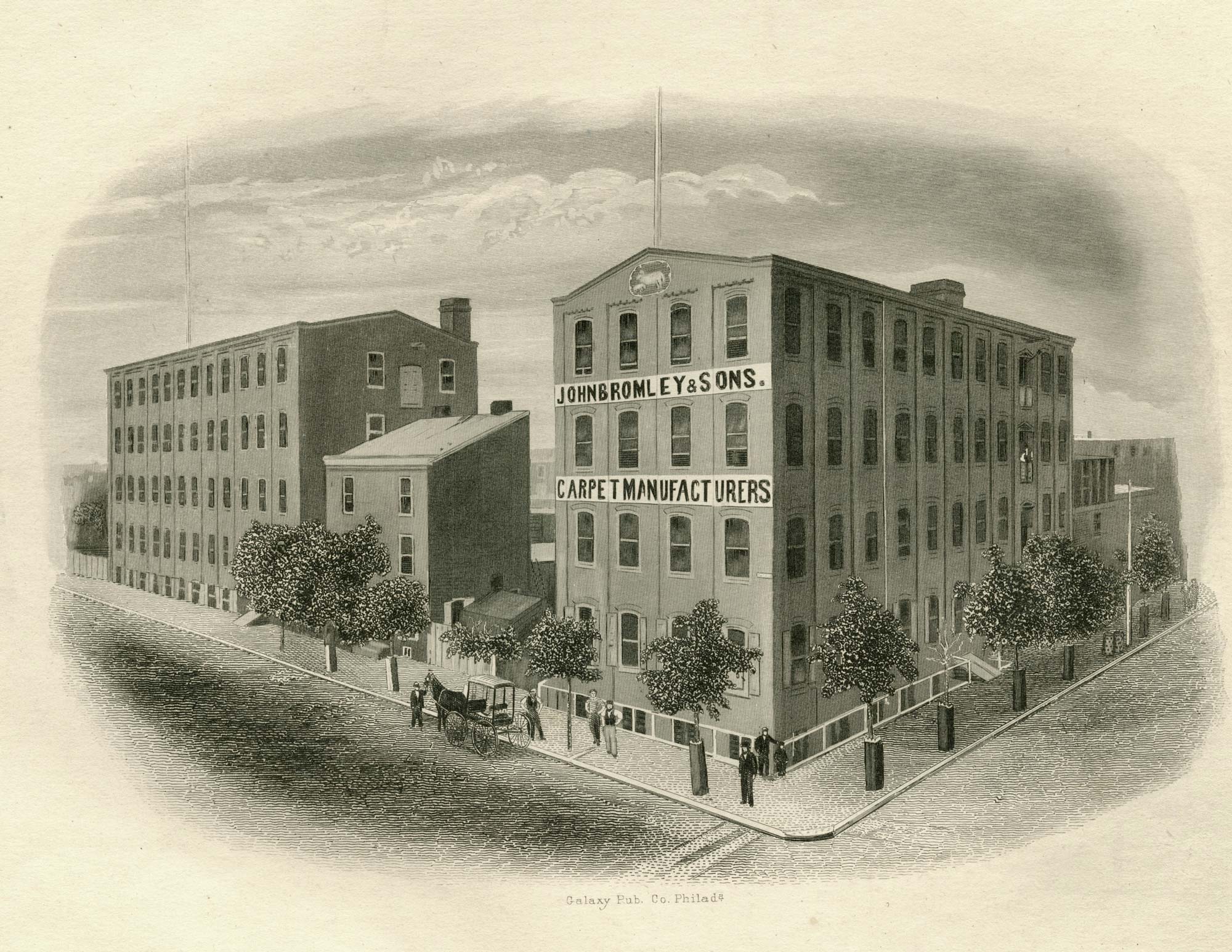
The original John Bromley mill at Front and York Streets, as it appeared in 1875. Society Print Collection, Historical Society of Pennsylvania.
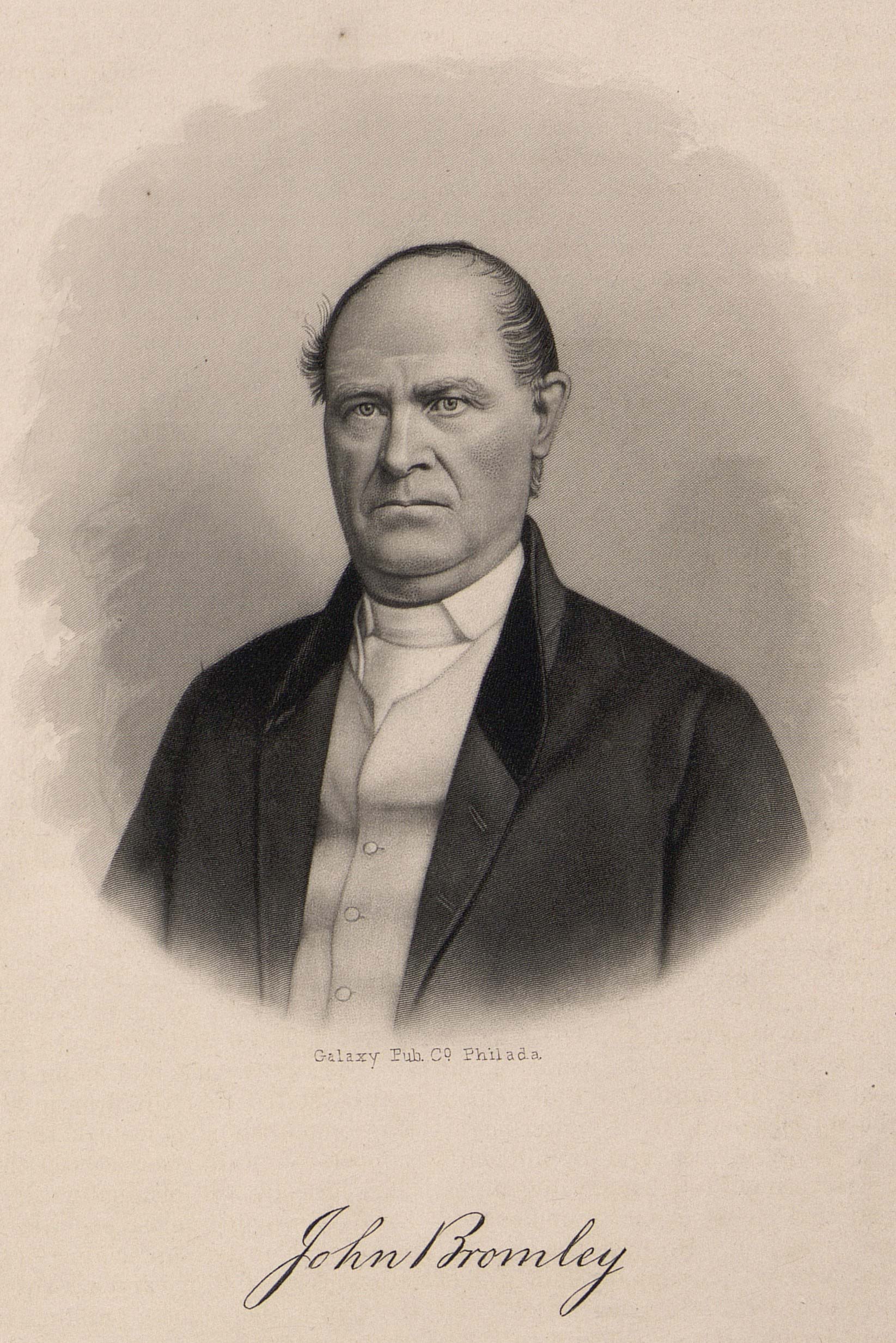
John Bromley, who immigrated to Philadelphia from England in 1840 and started a multi-generation family textile business in Kensington. Historical Society of Pennsylvania.
1860
John Bromley opens a carpet mill in Kensington, the first of several large family textile mills in the neighborhood
In 1860, English immigrant John Bromley opened a carpet mill at Front, Jasper, and York Streets in Kensington, the first of several textile mills built in the area by the Bromley family over the course of the late 19th and early 20th century. Employing thousands of workers making a wide range of textile products, the Bromley’s were among several family dynasties that made Kensington one of the world’s foremost textile manufacturing centers through the mid-20th century.
1871
Henry Disston begins moving his saw works to Tacony
English immigrant Henry Disston started the Keystone Saw Works near downtown Philadelphia in 1840 and moved it to Northern Liberties several years later. In 1855 Disston introduced the crucible steelmaking process to America and by the 1860s was one of the largest saw makers in the nation.
Needing more space, Disston began moving the company to a sprawling 50-acre riverfront site in Tacony in Northeast Philadelphia, where it grew into the largest saw manufacturer in the world. At its height, Disston employed some 4,000 workers who made nine million saws annually.
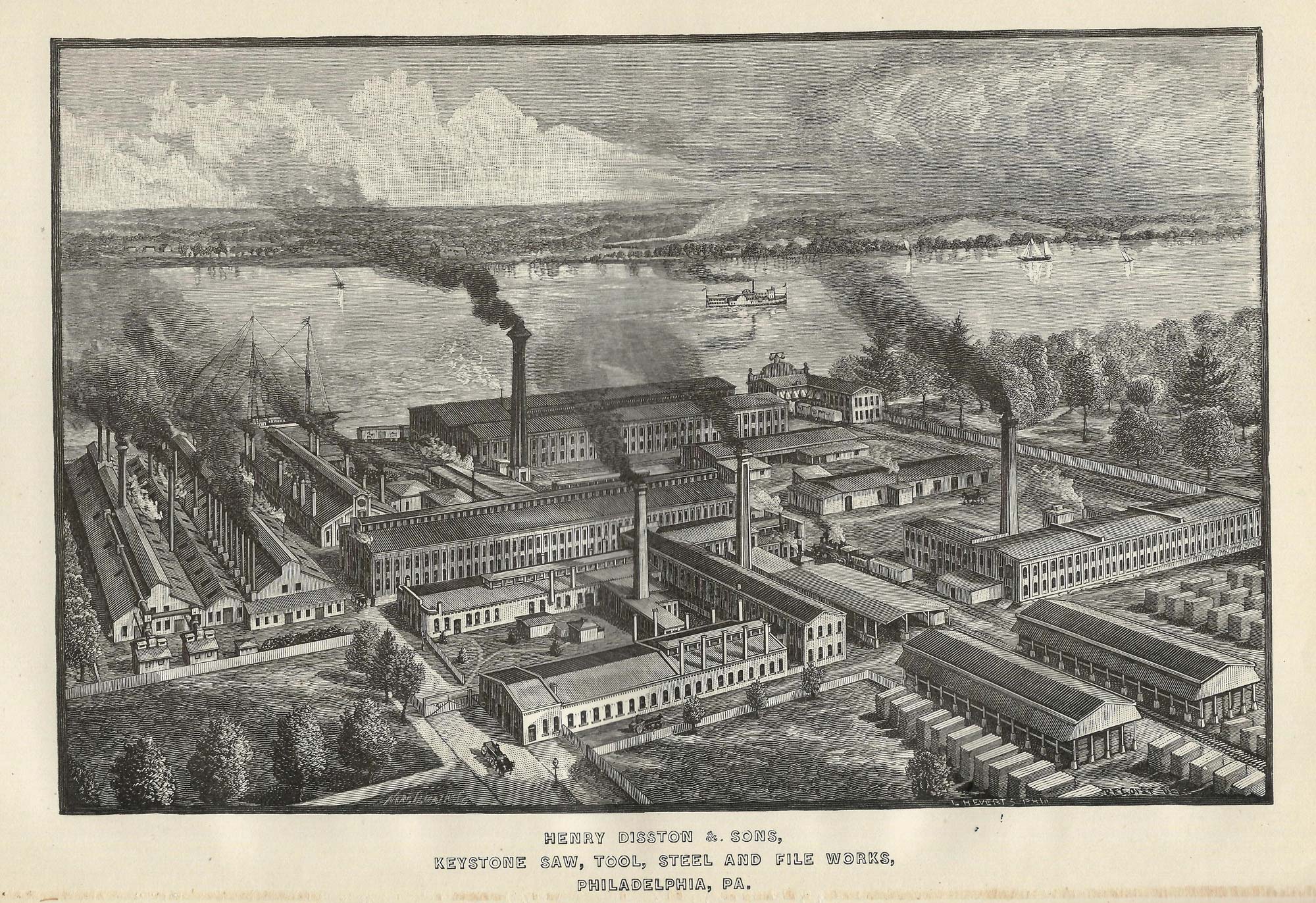
Aerial view of Disston complex in Tacony, 1884. Published in History of Philadelphia, 1609-1884, by Thomas Scharf and Thomson Westcott.
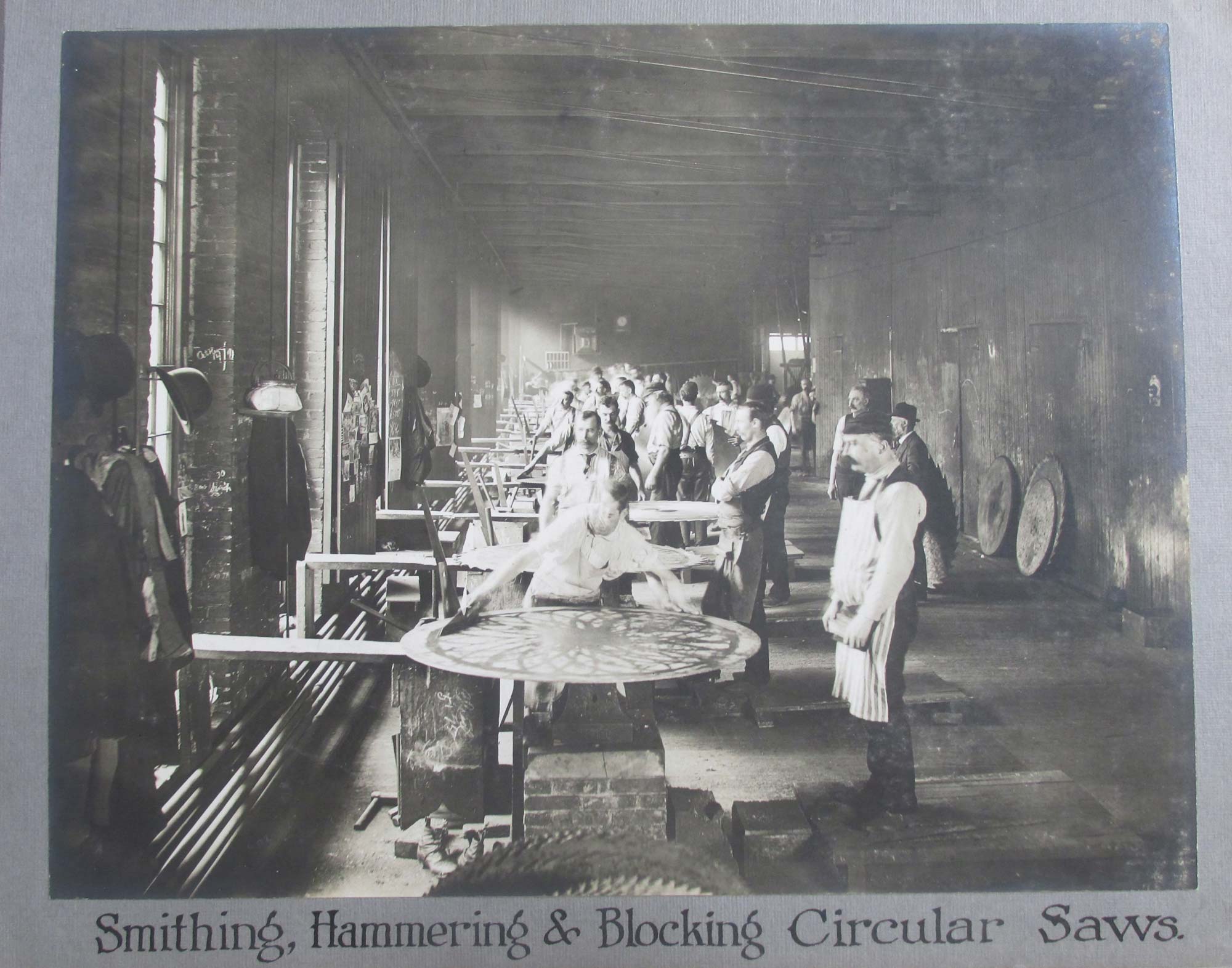
Working on circular saw blades at Disston Saw Works. Disston Factory Photo Album, Historical Society of Tacony.
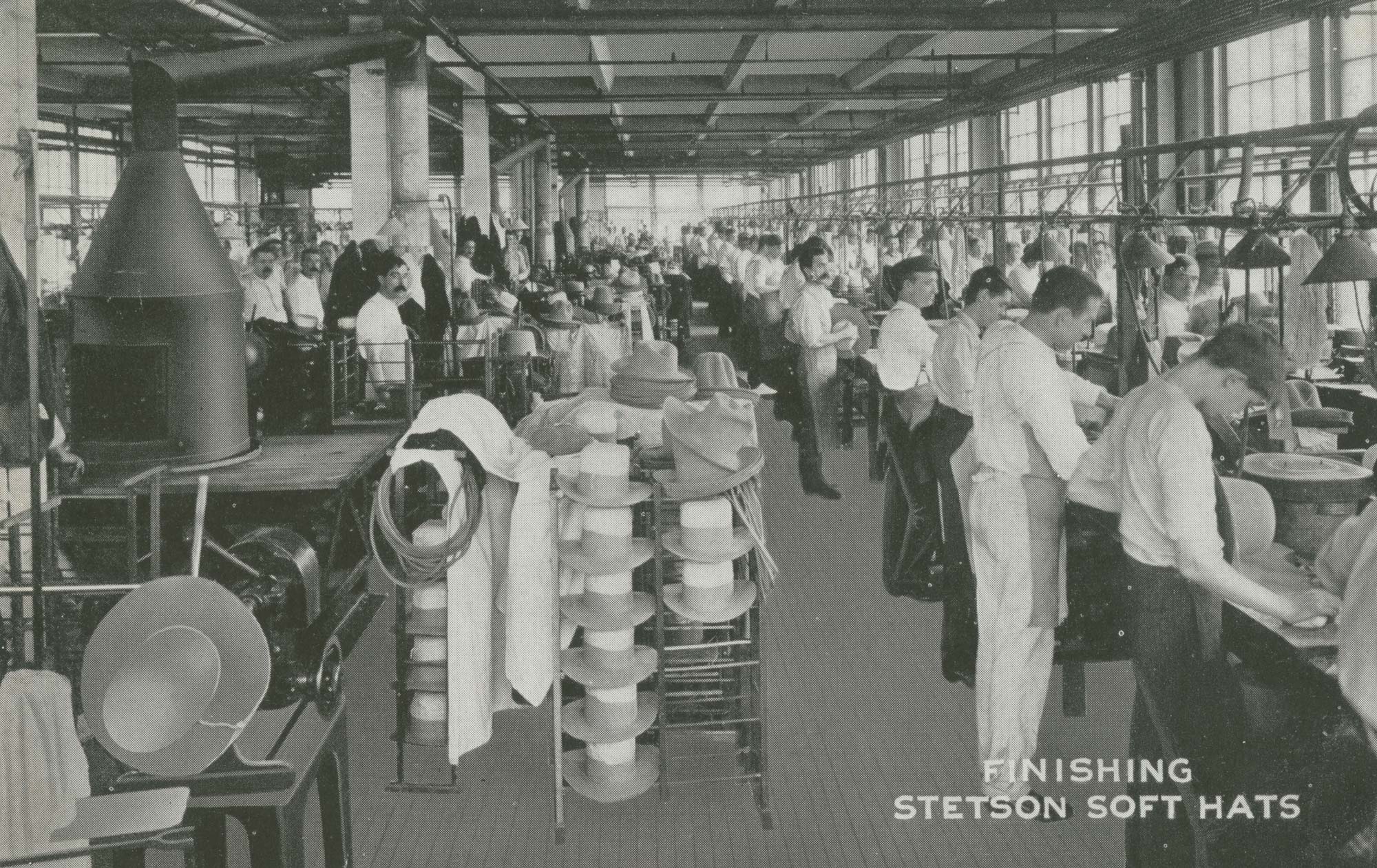
Finishing Soft Hats, John B. Stetson Company, c.1910. John B. Stetson Company Postcards, Library Company of Philadelphia.
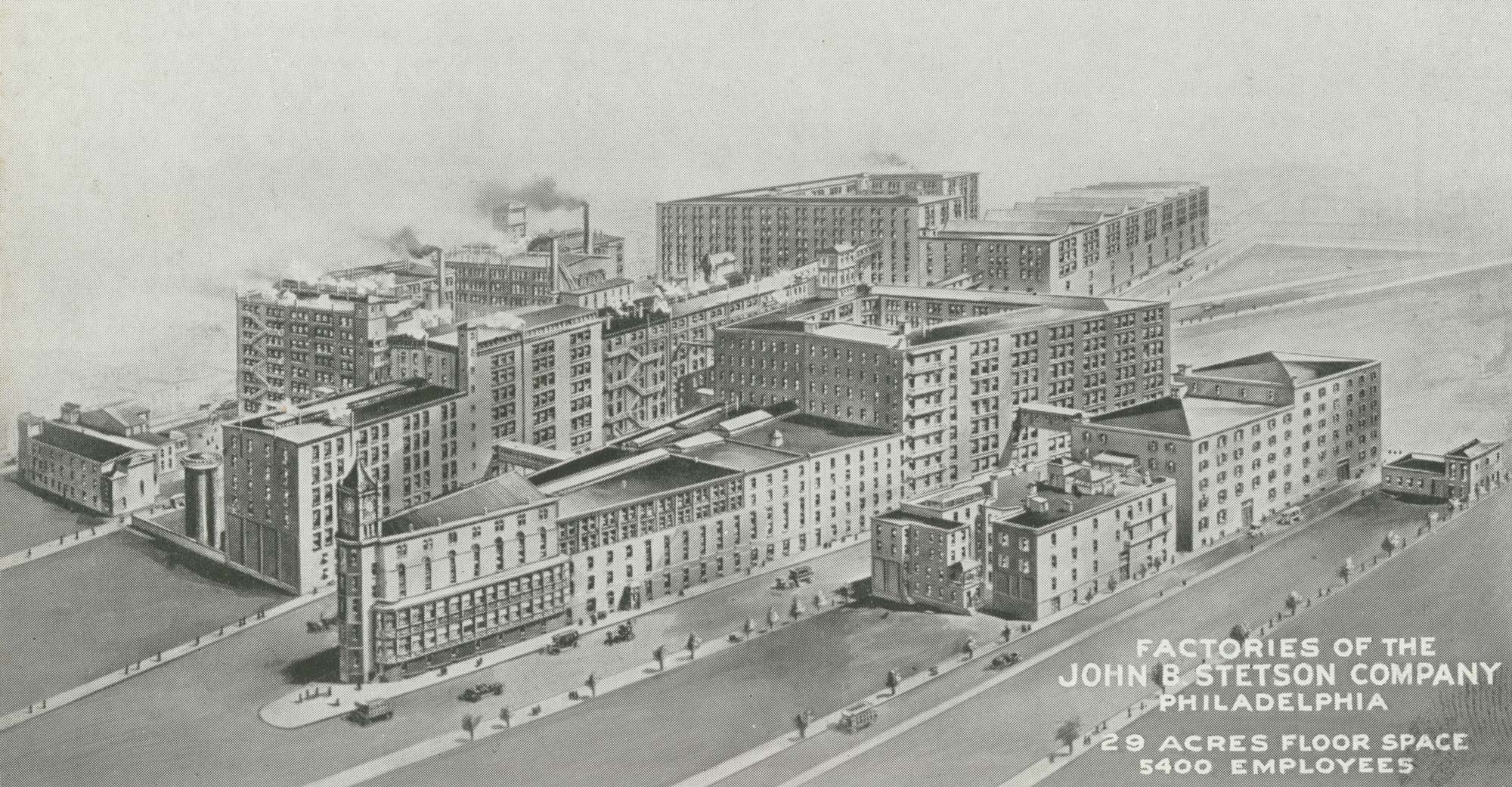
John B. Stetson Company, North Philadelphia complex, circa 1910. John B. Stetson Company Postcards, Library Company of Philadelphia.
1874
Stetson Hat Company moves to new factory in North Philadelphia
After spending time in the American West as a young man and noticing the poor quality of the headwear in that part of the country, John B. Stetson settled in Philadelphia in 1865 and began making hats. His company grew rapidly and in 1874 he moved it to a huge new complex at Germantown, North 5th, and Montgomery Avenues in North Philadelphia.
The company grew to be the largest hat maker in the nation, employing some 5,400 workers at its height. Stetson became known especially for its “Boss of the Plains” cowboy hat, seen in countless western movies and cowboy images.
1876
W. Atlee Burpee launches a company that would reshape American gardening
In 1876, Philadelphia entrepreneur W. Atlee Burpee founded a mail-order poultry and livestock business after recognizing growing demand from farmers for reliable, high-quality seed.
What began as a small operation quickly evolved into one of the most influential seed companies in the United States. Burpee pioneered research-based seed development, introduced innovative vegetable and flower varieties, and helped expand mail-order distribution across rural America.
From experimental farms in Pennsylvania to gardens across the country, Burpee helped transform American agriculture through innovation, quality, and horticultural research.
More than a century later, the company remains a symbol of American ingenuity and agricultural advancement.
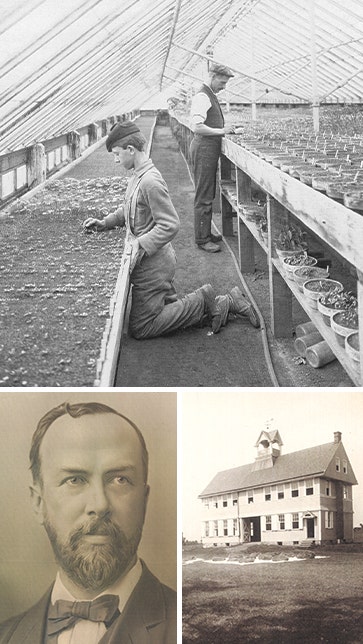
Courtesy of W. Atlee Burpee Company.
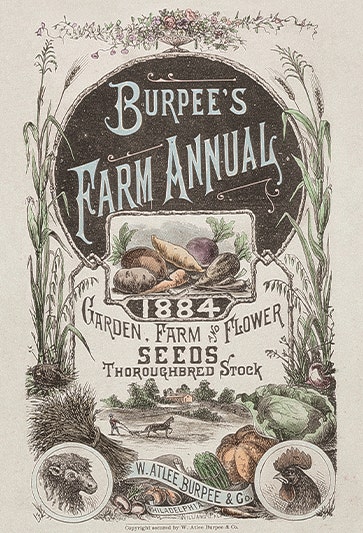
Courtesy of W. Atlee Burpee Company.
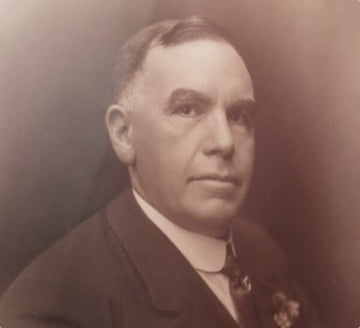
Courtesy of Cunningham Piano Company.
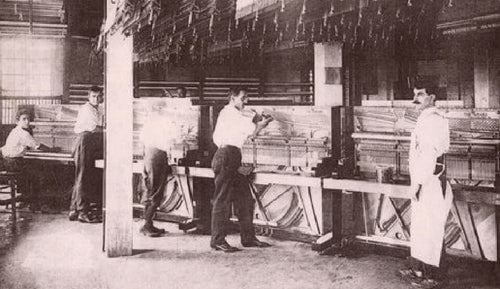
Courtesy of Cunningham Piano Company.
1891
Cunningham Piano Company brings craftsmanship and music together in Philadelphia
Founded in 1891 by Irish immigrant Patrick J. Cunningham, Cunningham Piano Company grew into one of Philadelphia’s most respected piano manufacturers through a commitment to craftsmanship, quality, and design.
The company earned national and international recognition for its instruments and became known for producing finely crafted pianos built to perform and last.
Like many American manufacturers, Cunningham faced major challenges during the Great Depression and World War II. After production ceased, the company evolved and focused on piano restoration, preserving historic instruments through skilled craftsmanship and precision work.
Today, Cunningham Piano continues that tradition in Philadelphia through one of the nation’s oldest and largest piano restoration facilities, where artisans restore musical instruments for future generations.
From manufacturing to restoration, Cunningham reflects the enduring legacy of American craftsmanship.
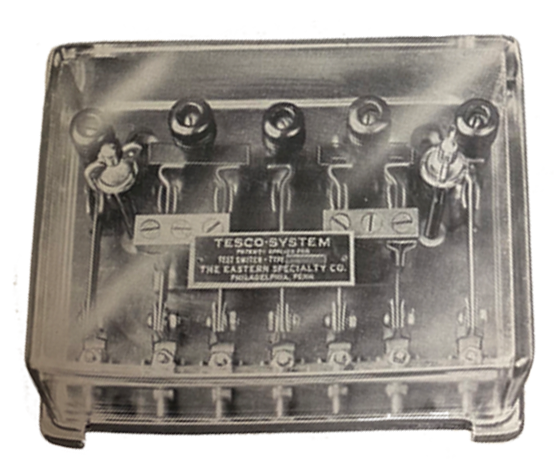
Courtesy of Tesco Metering.
1904
TESCO Metering helps power the American electric grid
Founded in Pennsylvania in 1904, TESCO Metering has supported the growth and reliability of the American electric grid for more than a century.
The company developed precision-built metering solutions and advanced testing systems used by utilities across the country to improve accuracy, safety, and system performance.
As the nation’s energy infrastructure evolved, TESCO continued to innovate while manufacturing its products in the United States and helping train the next generation of grid professionals.
From early electrical expansion to today’s modern power systems, TESCO reflects the long-standing role of American manufacturing in powering the nation forward.
1905
Drug manufacturers Powers & Weightman and Rosengarten & Sons merge
Philadelphia was one of nation’s leading pharmaceutical manufacturing centers in the 19th and early 20th century. Two of the city’s largest drug companies, Powers & Weightman and Rosengarten & Sons, founded in 1818 and 1822, respectively, were manufacturing chemists and makers of quinine.
They merged in 1905 to form the pharmaceutical giant, Powers-Weightman-Rosengarten Company, which operated in Philadelphia until it was bought out by Merck & Company in 1927 and moved to New Jersey.
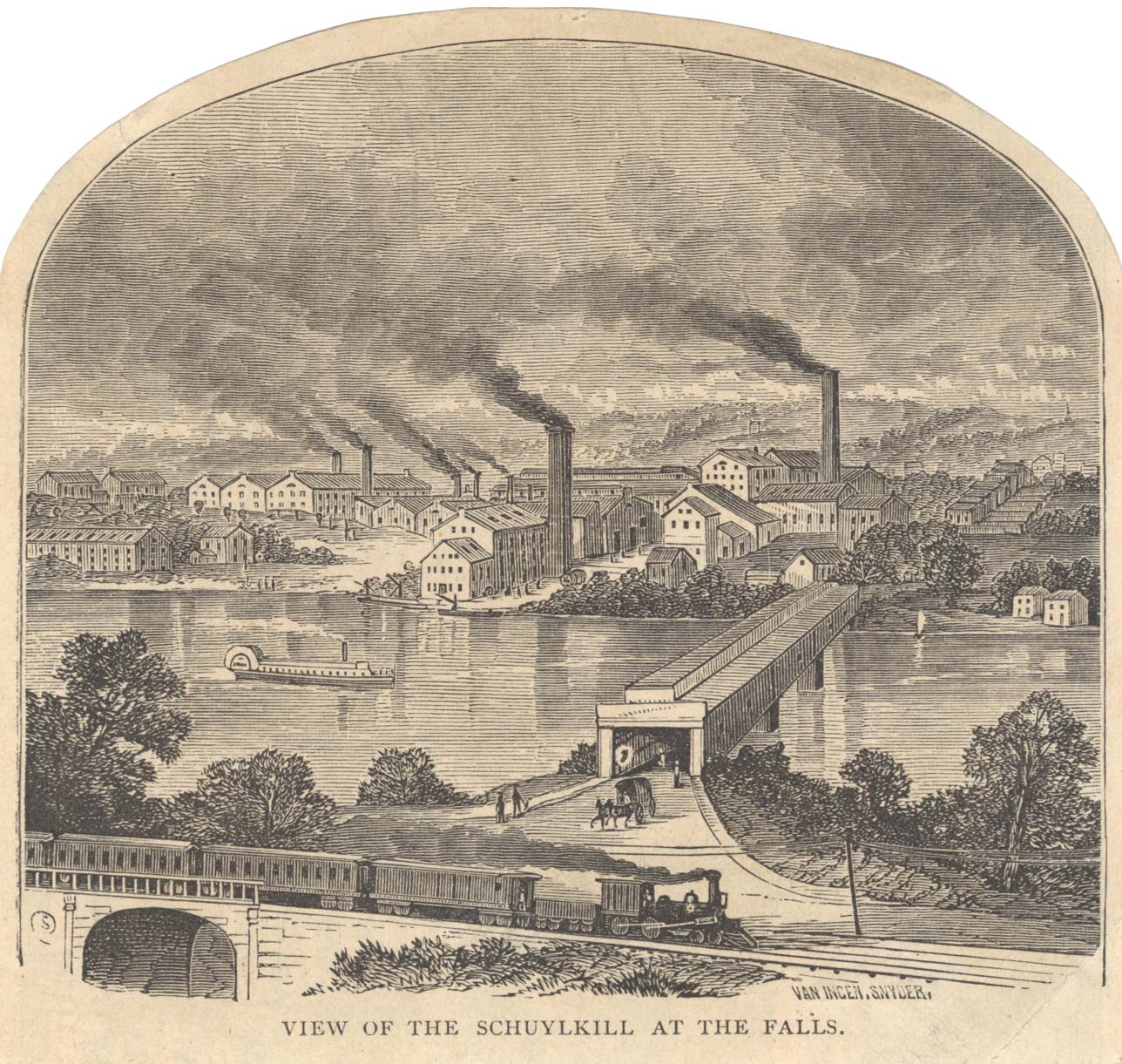
Powers & Weightman, Manufacturing Chemists, East Falls plant, mid-19th century. Society Print Collection, Historical Society of Pennsylvania.
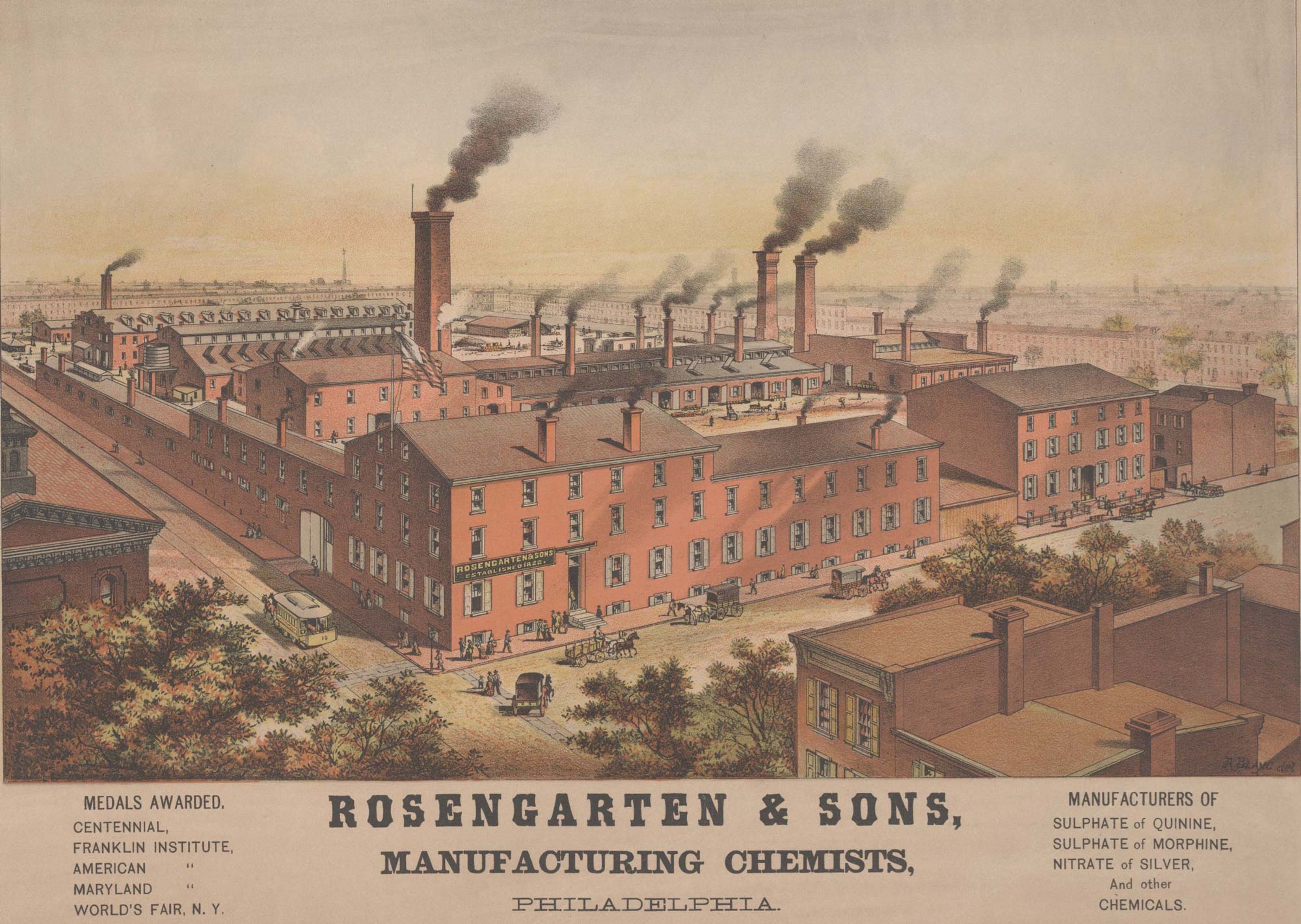
Rosengarten & Sons, Manufacturing Chemists, South Philadelphia plant, circa 1876. Print and Picture Collection, Free Library of Philadelphia.
1918
Vibration Specialty Corporation advances precision balancing technology
Founded in 1918 by Russian immigrant Nicholas Wladimir Akimoff, Vibration Specialty Corporation was built on breakthrough engineering in machine balancing and vibration analysis.
Akimoff developed and patented an advanced balancing machine capable of delivering highly accurate readings at low rotational speeds. The technology became essential for balancing large industrial rotors, turbines, generators, and critical naval components.
VSC balancing systems played a role in major industrial advancements throughout the 20th century, including work connected to Henry Ford’s Model T production challenges, Thomas Edison’s turbine systems, and silent submarine propellers developed for the U.S. Navy.
The company also pioneered early vibration analysis technology, including one of the first triaxial instruments for machine condition monitoring.
For more than a century, VSC has reflected the power of American manufacturing through engineering innovation, precision, and industrial problem solving.
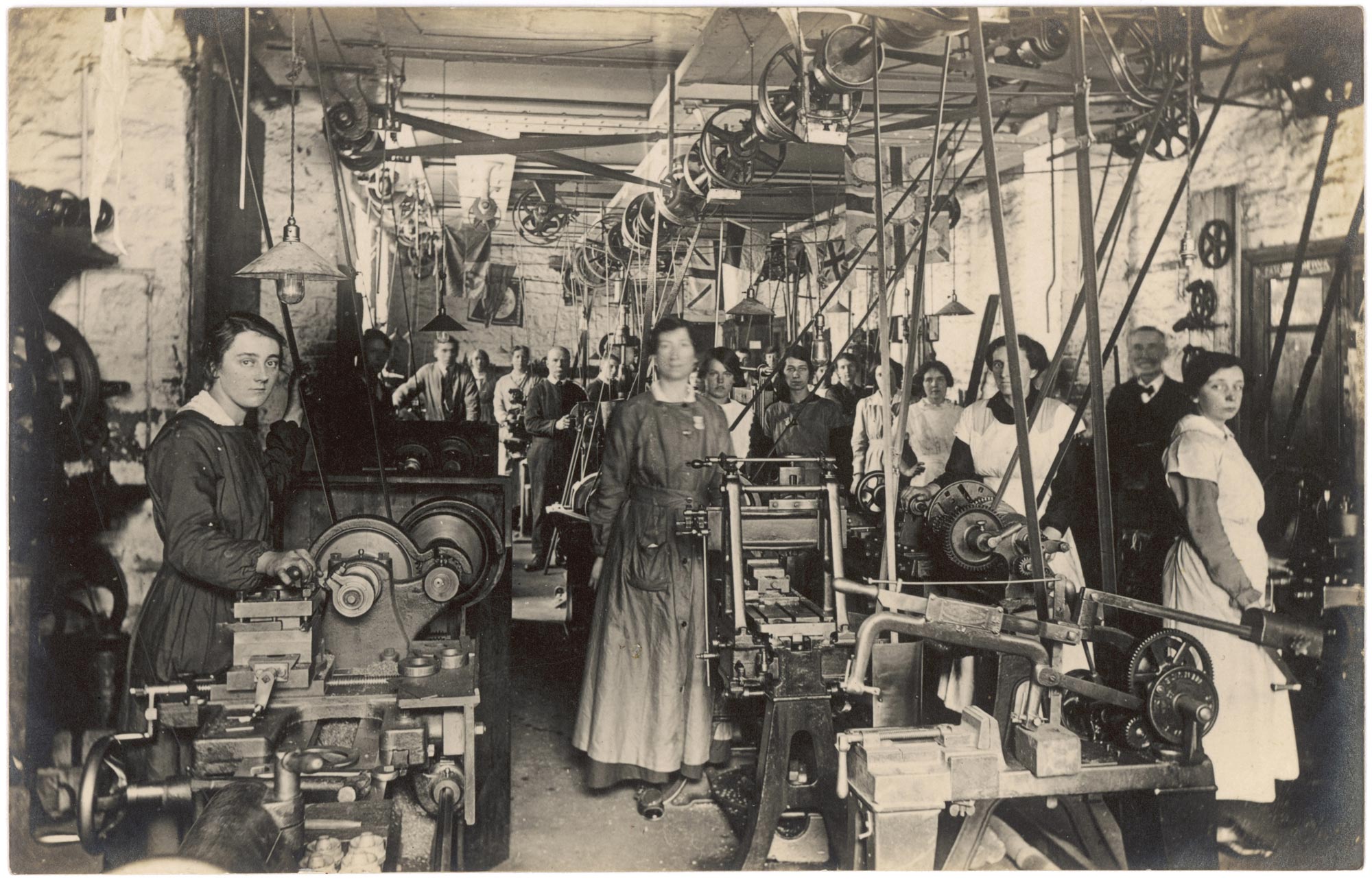
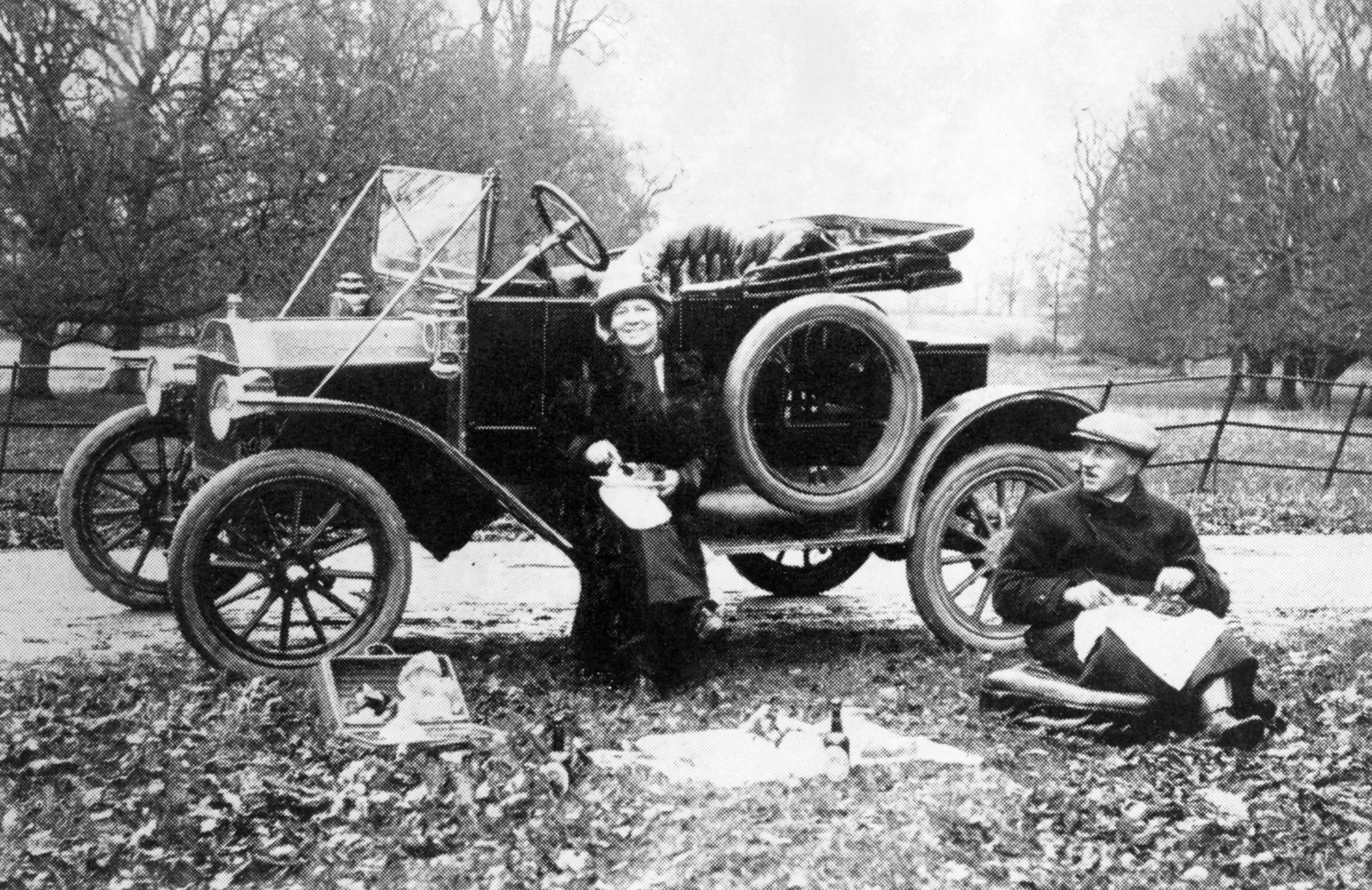
Stock photos.
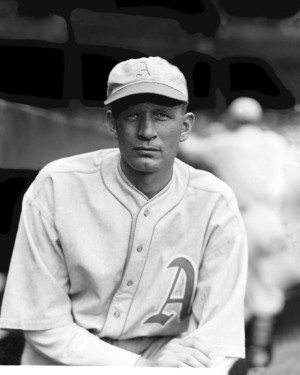
Howard Ehmke. Courtesy of Ehmke Manufacturing.
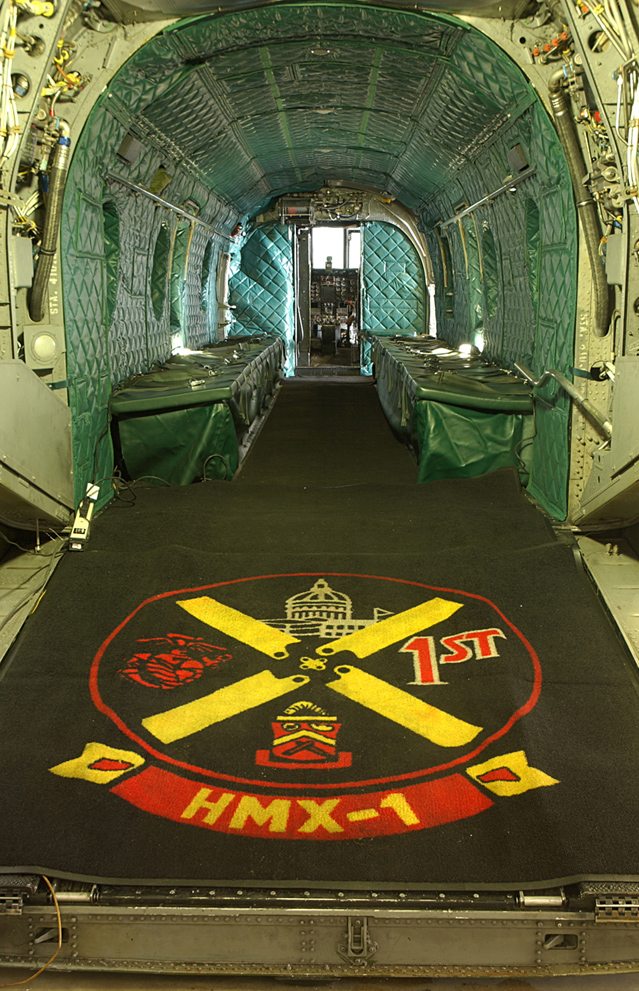
Courtesy of Ehmke Manufacturing.
1929
Ehmke Manufacturing grows from a World Series moment into a defense manufacturing leader
In 1929, former Philadelphia Athletics pitcher Howard Ehmke approached manager Connie Mack with an idea for protecting baseball fields from rain using a large canvas tarpaulin. Mack backed the idea, and Ehmke Manufacturing Company was born.
What started with athletic field covers evolved into a major American manufacturer serving the U.S. Armed Forces, defense contractors, and industrial markets.
Over the decades, Ehmke Manufacturing expanded into engineered fabric products including tactical gear, military bags and cases, aviation thermal and acoustic blankets, vehicular covers, and support systems for military aircraft and field operations.
The company’s products have supported major defense programs including the Boeing CH-47 Chinook and V-22 Osprey.
From the baseball diamond to national defense, Ehmke Manufacturing reflects the adaptability, ingenuity, and precision of American manufacturing.
1933
Rohm & Haas introduces Plexiglass
Founded in Germany in 1907 to manufacture a leather tanning product, the Rohm & Haas company established a Philadelphia office two years later, under the direction of Otto Haas. During World War I, the Philadelphia branch broke off and was incorporated as a separate company and in 1921 it took over the former Lenning Chemical Company in Bridesburg.
In 1933, the company introduced Plexiglass, the lightweight, shatter-proof clear plastic that found a wide range of uses, from aircraft cockpits to general consumer applications. By 1999, Rohm & Haas was the largest specialty chemical company in the world.
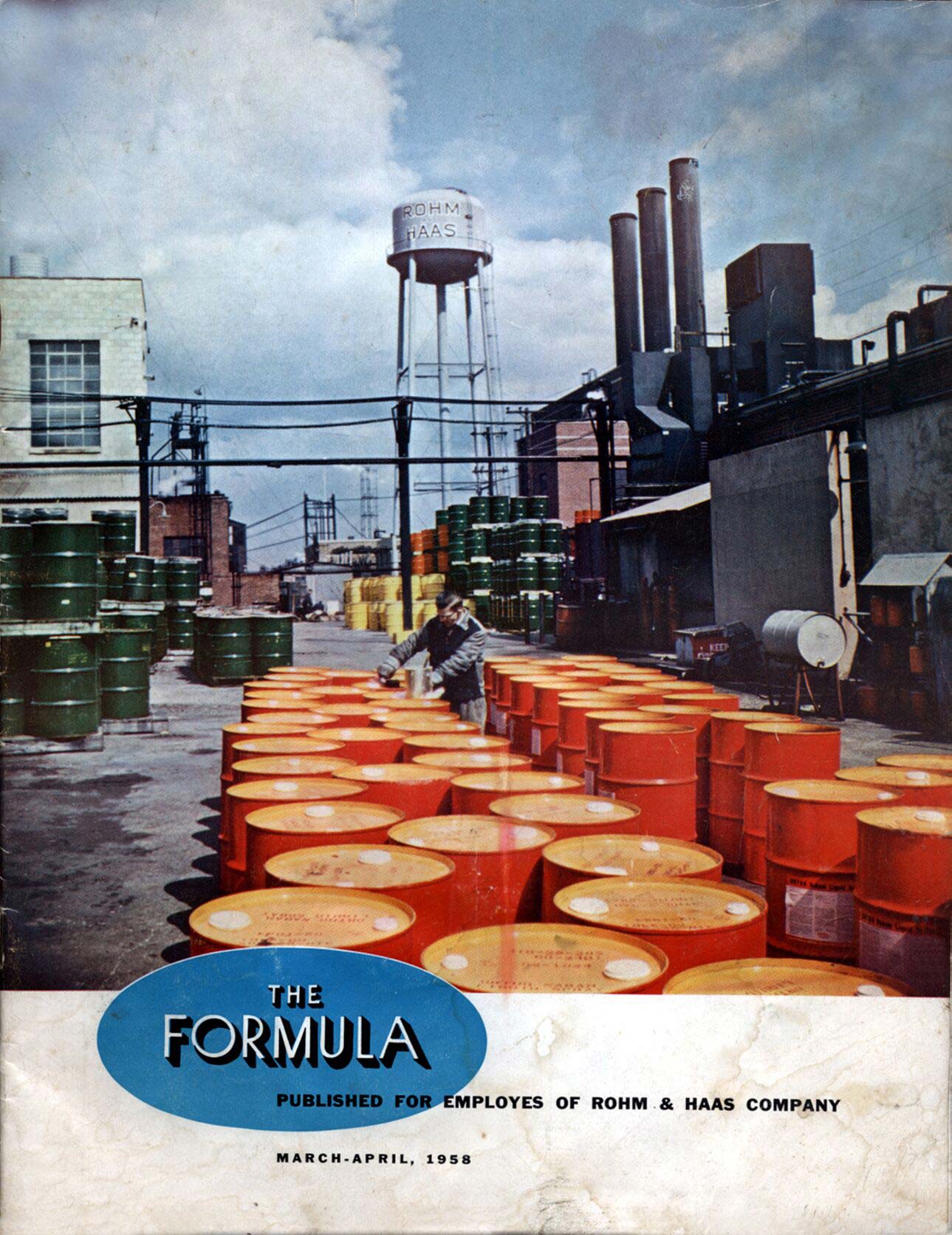
Cover page of March-April 1958 edition of Rohm & Haas employee magazine, The Formula, showing a view of the company’s plant in Bridesburg. Image retrieved online, no credit given.
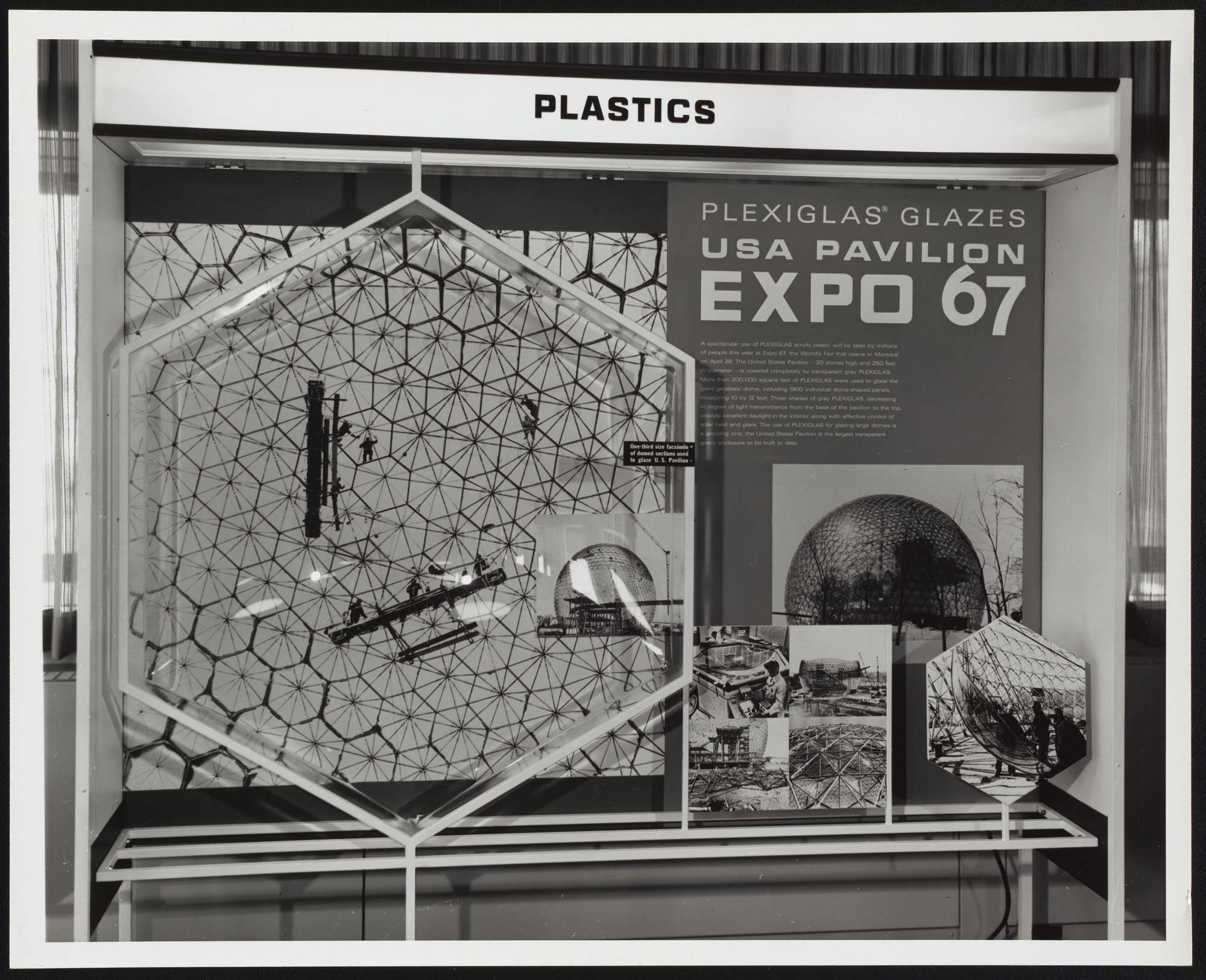
Rohm & Haas Plexiglass display at the 1967 World Expo in Montreal. Science History Institute.
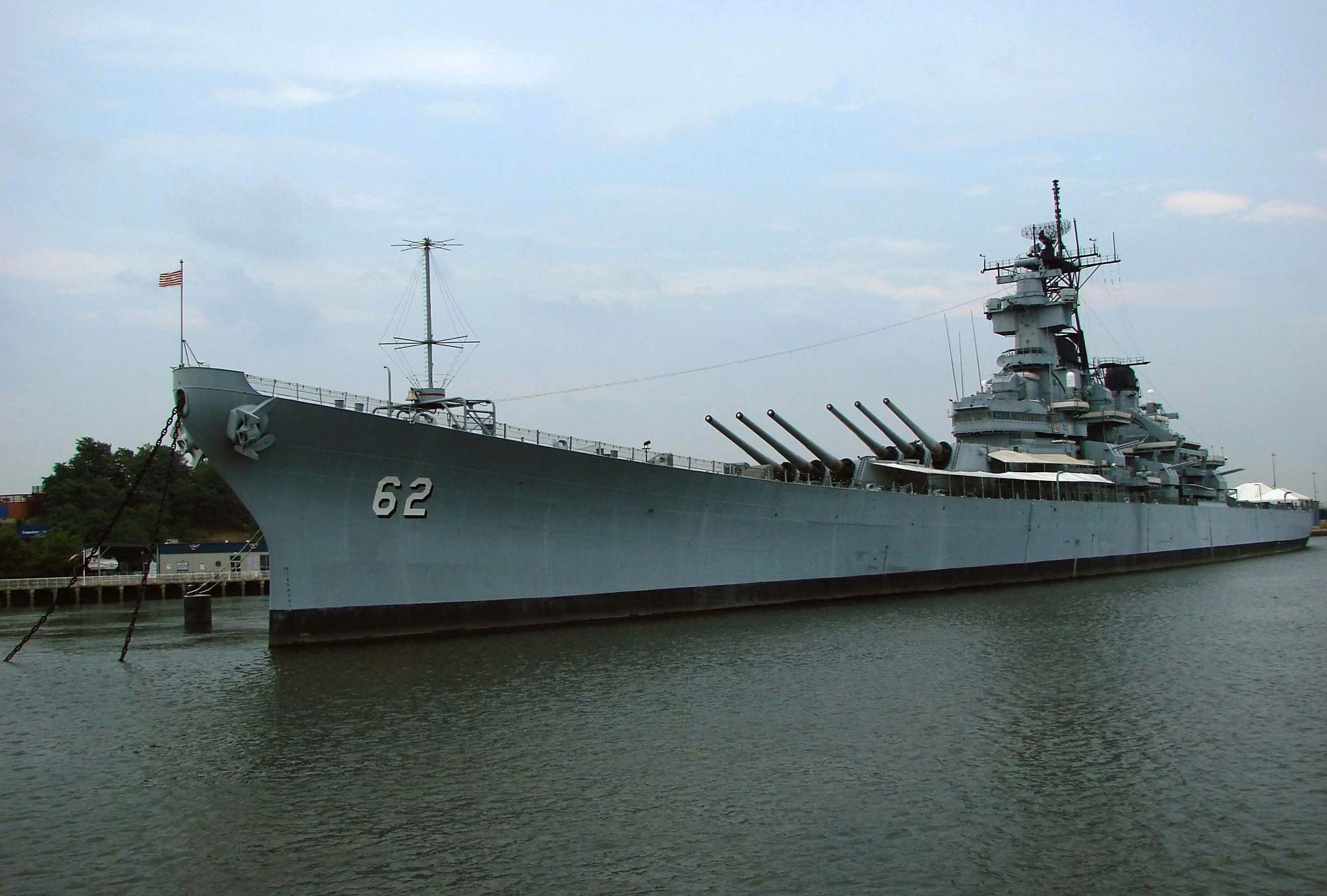
USS New Jersey, which launched from the Philadelphia Navy Yard in 1942. Photo by Vladsinger, 2008, Wikipedia Commons.
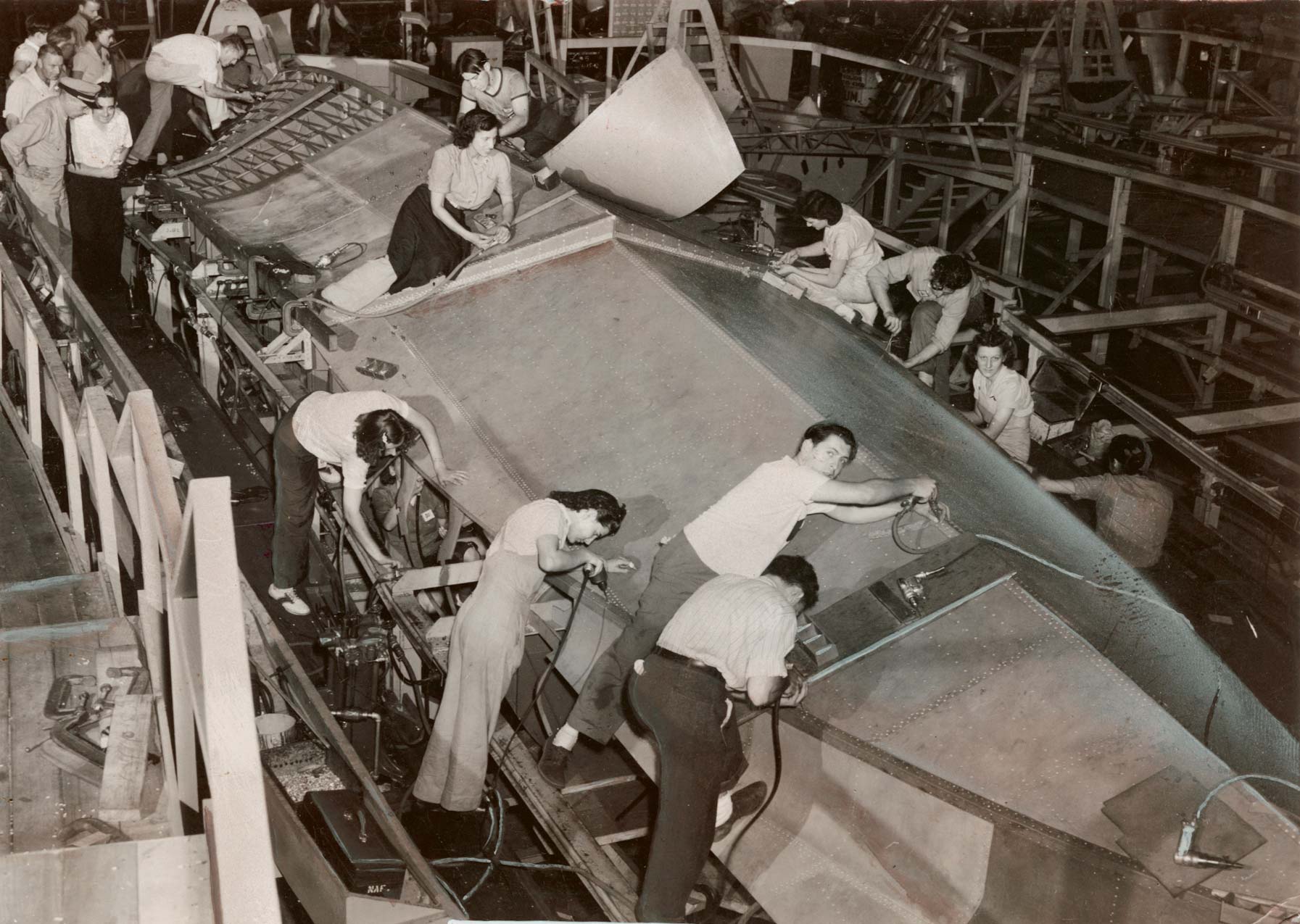
Male and female employees work on the undercarriage of an aircraft bomber at the Navy Yard, 1942. Philadelphia Record Photograph Collection, Historical Society of Pennsylvania.
1942
Battleship New Jersey launched from Philadelphia Navy Yard
The Philadelphia Navy Yard moved from its original location in Southwark to the 800-acre League Island site at the southern edge of the city in the years following the Civil War. By 1876, the move was complete. The Navy Yard was one of the government’s key shipbuilding facilities during World Wars I and II.
The battleship New Jersey was built there and launched on December 7, 1942, exactly one year after the Japanese attack on Pearl Harbor. One of the most decorated battleships in US naval history, the USS New Jersey was decommissioned in 1991 and is now a floating museum on the Delaware River in Camden, New Jersey. The Philadelphia Navy Yard also built aircraft during World War II.
1946
World’s first all-purpose digital computer unveiled at University of Pennsylvania
ENIAC—Electronic Numerical Integrator and Computer—was invented by J. Presper Eckert and John W. Mauchly at the Moore School of Electrical Engineering at the University of Pennsylvania in the mid-1940s and unveiled at Penn in February 1946.
The world’s first programmable, electronic, general-purpose digital computer, it was initially used by the US Army for rapid military calculations. The two inventors left Penn and formed Eckert-Mauchly Computer Corporation, which in 1951 introduced UNIVAC—Universal Automatic Computer—the first commercially produced electronic digital computer designed for business use. These Philadelphia inventions
ushered in the computer age and would eventually revolutionize manufacturing.
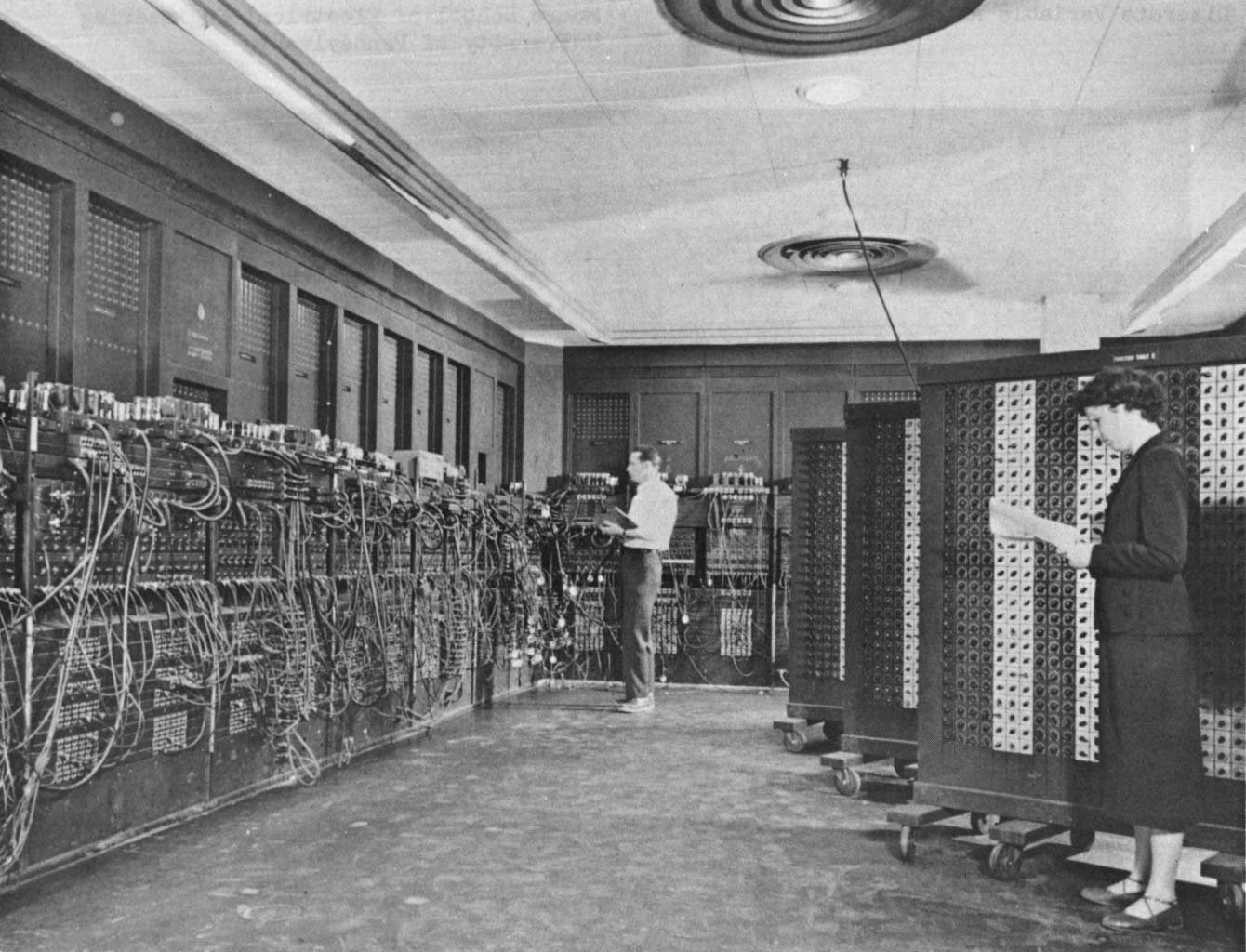
Two technicians work at ENIAC, 1940s. US Army photo
1960
Philadelphia Industrial Development Council develops its first major industrial site
The Philadelphia Industrial Development Council, a public/private economic development corporation established in 1958, executed its first major transaction when it arranged for Whitman’s Chocolate to occupy a new 400,000 square-foot facility in Northeast Philadelphia.
PIDC worked to ensure that Whitman’s, the renowned candy maker that began in 1842 in Philadelphia and needed for more space for its operations, stayed in the city rather than moving away. PIDC would go on to develop numerous industrial sites throughout Philadelphia to ensure that manufacturing continues in the city.
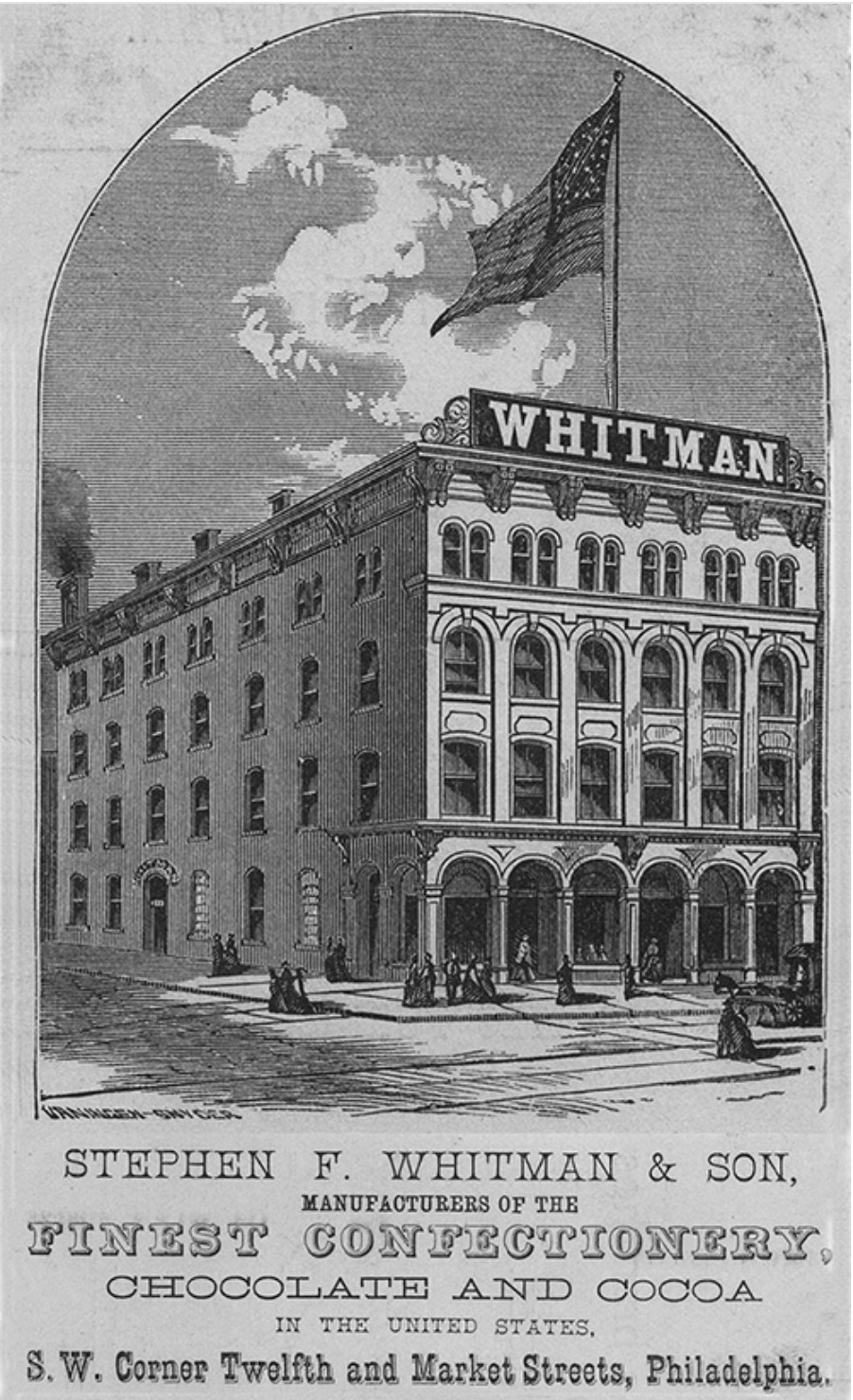
The Whitman building at 12th and Market Streets, as depicted in an ad published in 1860. With assistance from the Philadelphia Industrial Development Corporation, the company moved to Northeast Philadelphia in 1960.
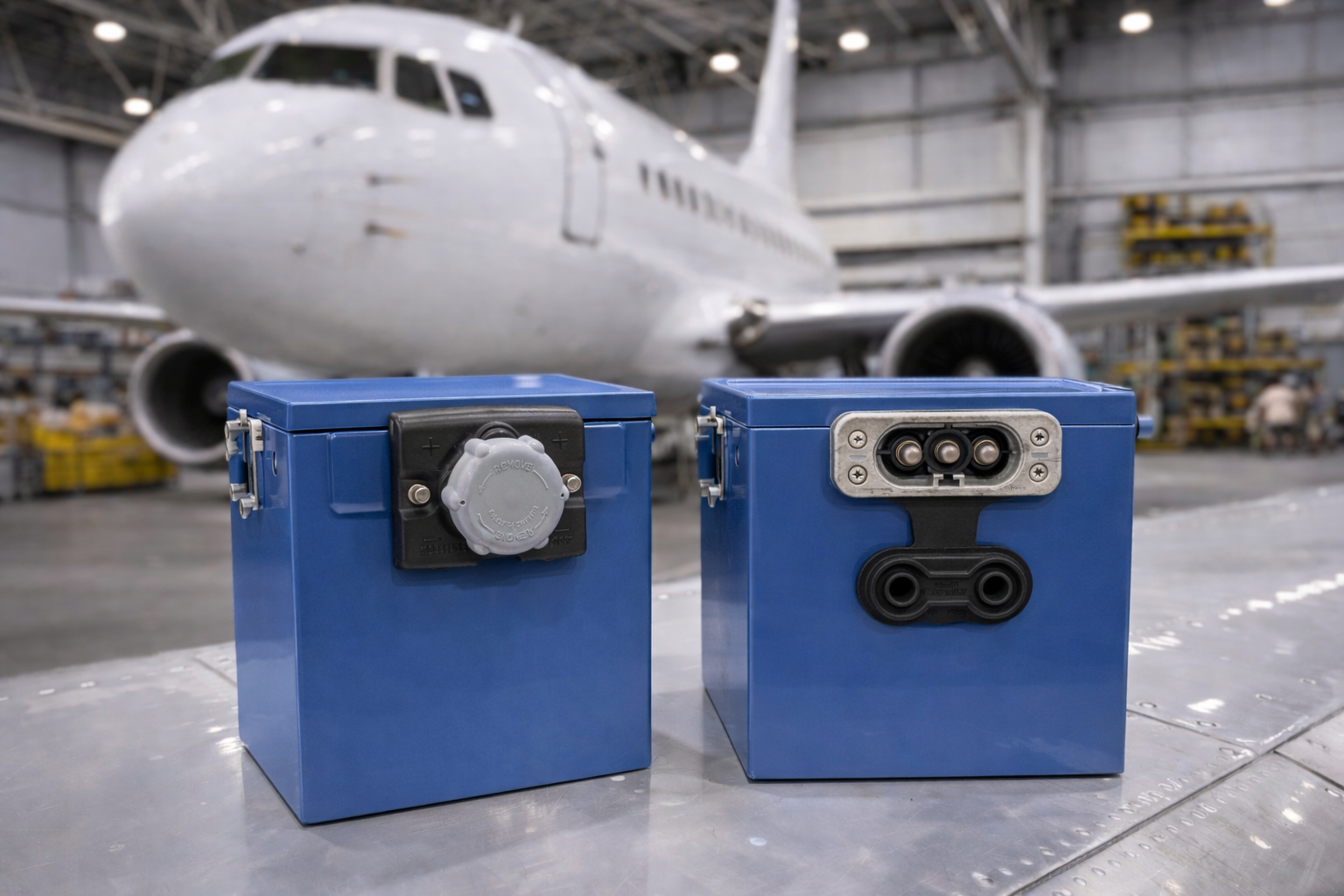
Courtesy of Rebling.
1962
Rebling Plastics advances precision manufacturing across critical industries
Founded in 1962, Rebling Plastics built its reputation through precision molded components serving aerospace, defense, medical, industrial, and energy applications.
Its molded components and high-amperage connectors have been used in commercial and military aircraft for decades, supporting some of the most widely used aircraft platforms built over the last 50 years.
The company also helped pioneer manufacturing techniques for advanced ammunition systems and innovative electrical connections for large-scale energy storage applications.
From aerospace to advanced energy systems, Rebling Plastics reflects the evolution of American manufacturing through innovation, precision, and engineering expertise.
1971
Powell Electro Systems founded to solve complex manufacturing challenges
Powell Electro Systems was founded in 1971 to support advanced manufacturing needs in the Philadelphia region. The company became a custom tube manufacturing operation for DuPont, helping produce flexible Teflon tubing sets used in one of the first-generation blood analyzers.
The project required precision engineering and innovative manufacturing solutions. Through its work with DuPont, Powell established a strong foundation in electro-mechanical manufacturing and complex assembly production.
Over the decades, the company expanded its capabilities and became known for solving difficult manufacturing problems through engineered solutions and reliable production.
Today, Powell Electro Systems manufactures complex wire harnesses and electro-mechanical assemblies while continuing the company’s long-standing focus on innovation and precision manufacturing, built on the mantra that “Our Connections Power Innovation.”
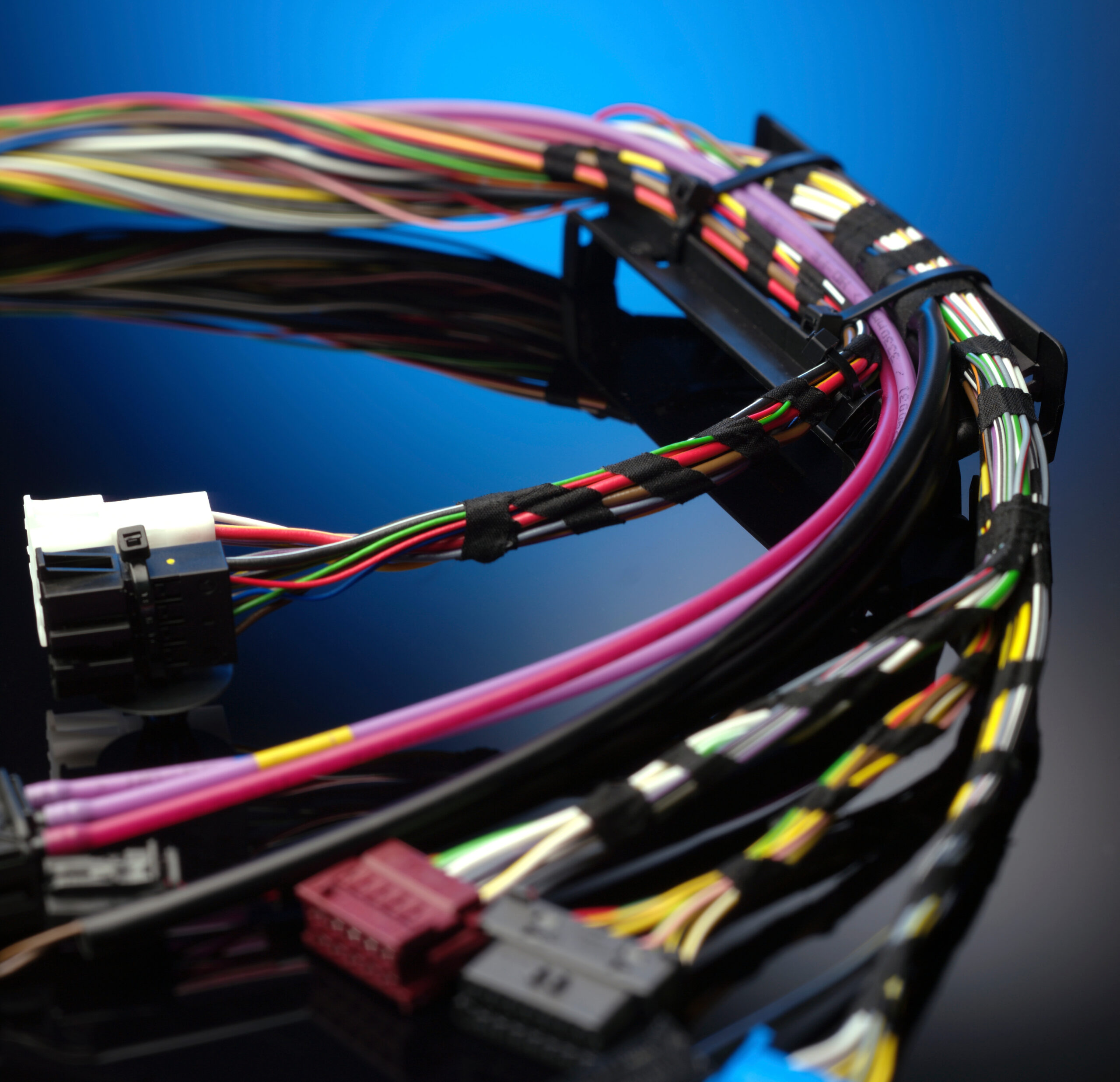
Stock image.
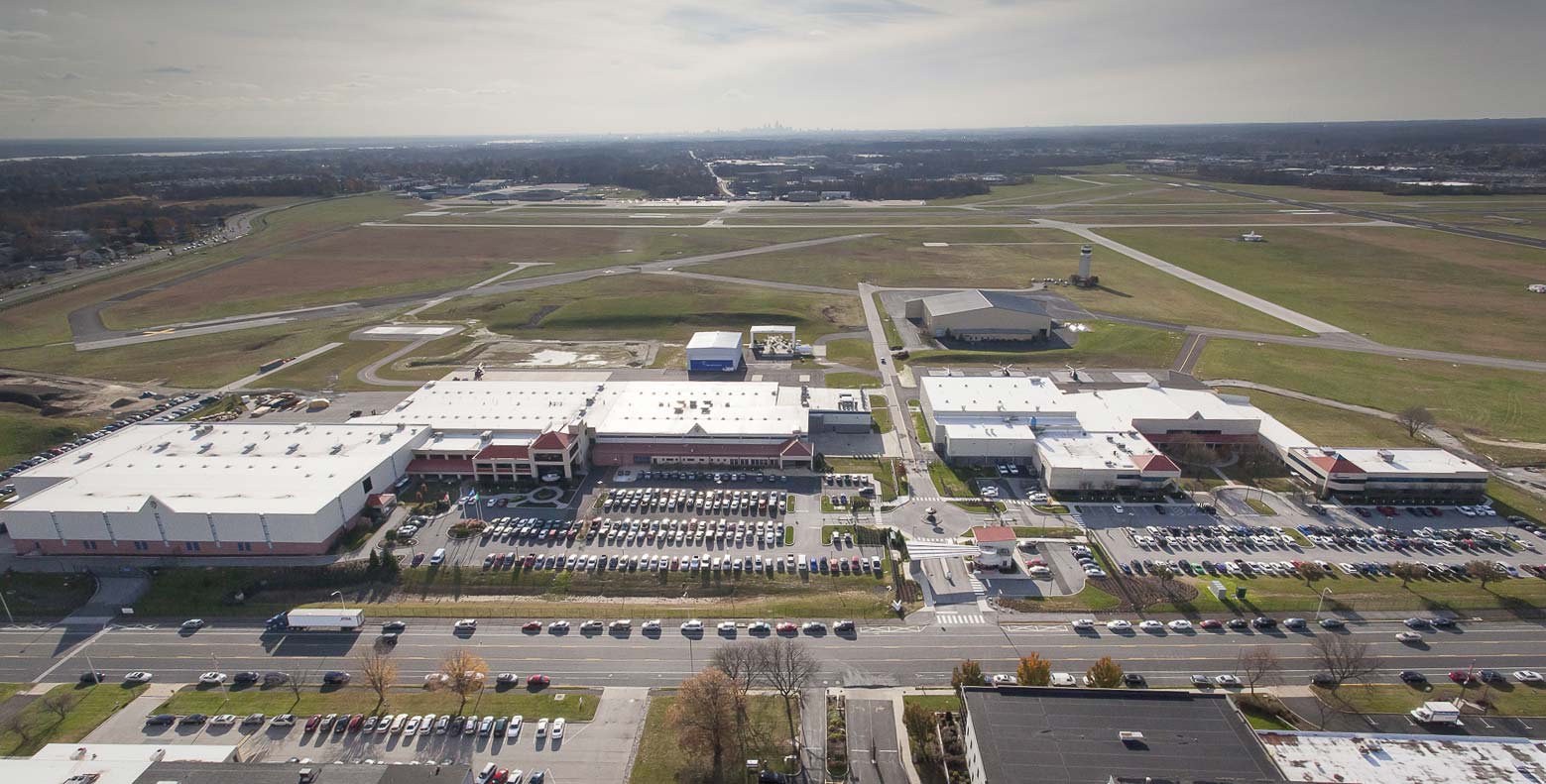
Aerial view of Leonardo Helicopters complex adjacent to North Philadelphia airport in Northeast Philadelphia. The site is both a manufacturing and training facility. Courtesy of Leonardo.
1980
Leonardo Helicopters establishes site in Northeast Philadelphia
Philadelphia has long been an important center for helicopter manufacture, beginning in the 1940s with pioneering work by Frank Piasecki, whose company was later acquired by Boeing. In 1980, English-Italian helicopter company, AugustaWestland, opened a repair and support site adjacent to North Philadelphia airport.
It upgraded and expanded the facility over the years and began manufacturing helicopters there in 2003. In 2016, AugustaWestland became Leonardo Helicopters. Currently one of the biggest employers in Northeast Philadelphia, Leonardo manufactures helicopters and operates a major training program at their Northeast Philadelphia site.
1982
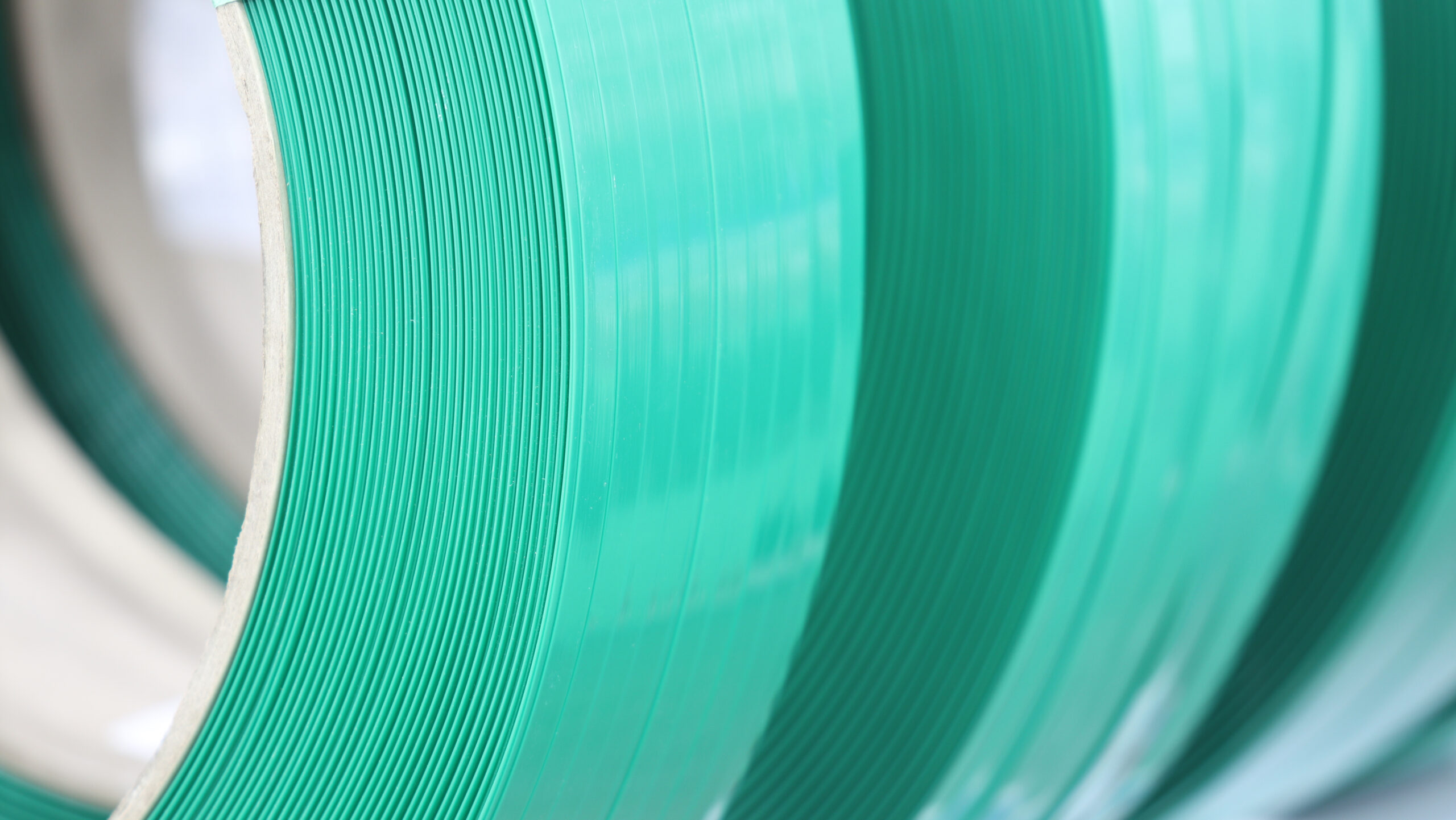
PAC Strapping grows from an entrepreneurial idea into a manufacturing success story
PAC Strapping began with two entrepreneurs commuting into Philadelphia on SEPTA. Ed Brownley Jr. and Pete Silvester shared an idea, built a business plan, and secured funding to purchase equipment for manufacturing strapping buckles and seals.
From that foundation, they launched Packaging Accessories Company, later known as PAC Strapping.
Built through hard work, family involvement, and steady growth, the company expanded from a small startup into a manufacturing organization generating more than $30 million in annual revenue.
PAC Strapping reflects the entrepreneurial spirit that continues to drive American manufacturing forward.
Stock image.
1996
Philadelphia Naval Shipyard decommissioned, taken over by commercial shipbuilding company
After 195 years of operation on the Delaware River—from 1801 to 1875 in Southwark, from 1875 to 1996 at League Island at the southern edge of the city, the Philadelphia Naval Shipyard was decommissioned by the US Navy in September 1996.
The shipbuilding part of the complex was taken over by Norwegian company, Kvaerner, which began constructing large container ships there in 2000. The site changed hands and names several times over the years. Now called Philly Shipyard and owned by a South Korean company, Hanwha, it manufactures large tankers, container ships, and special purpose vessels.
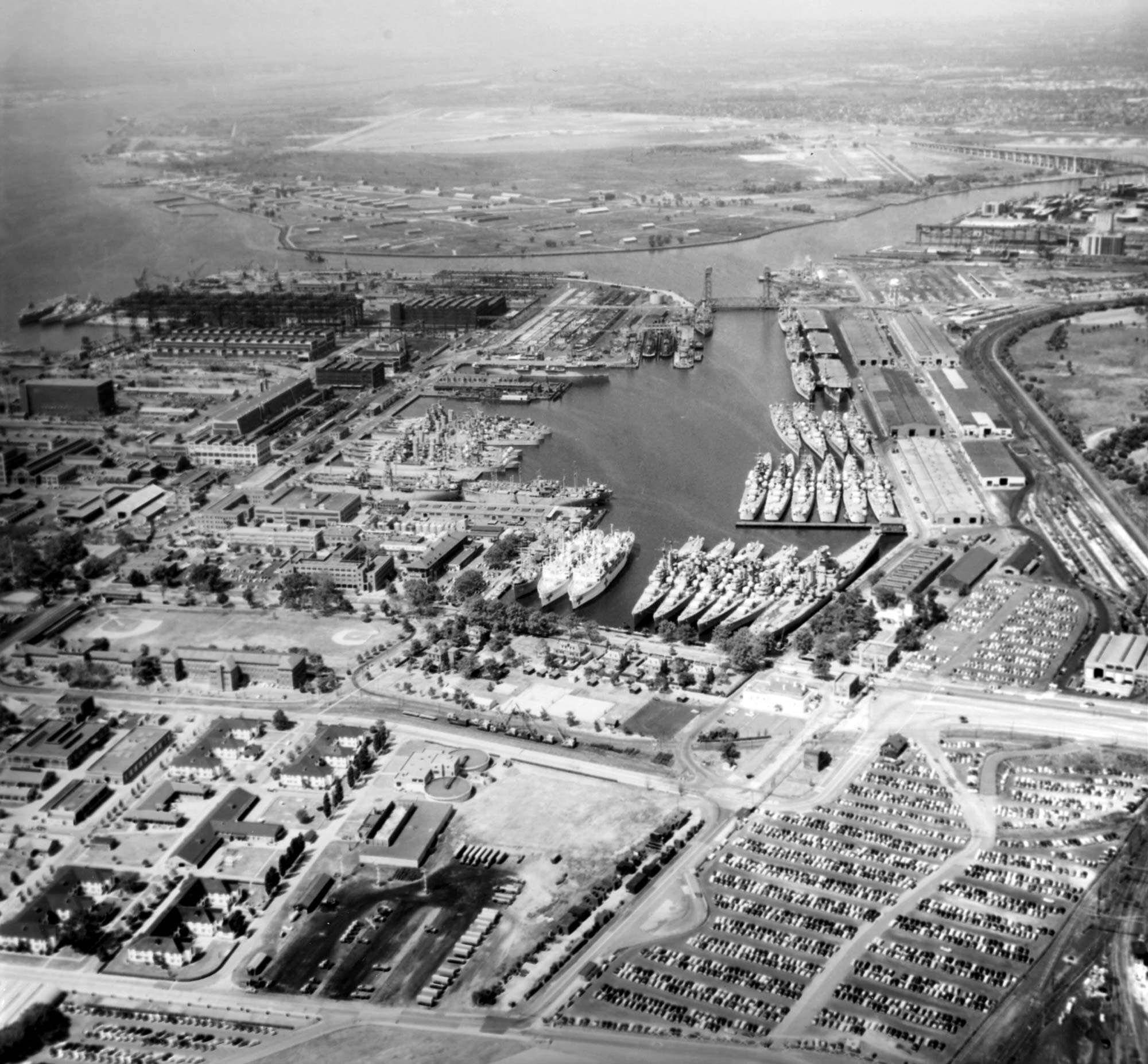
Aerial view of Philadelphia Naval Shipyard in 1955. US Navy photo.
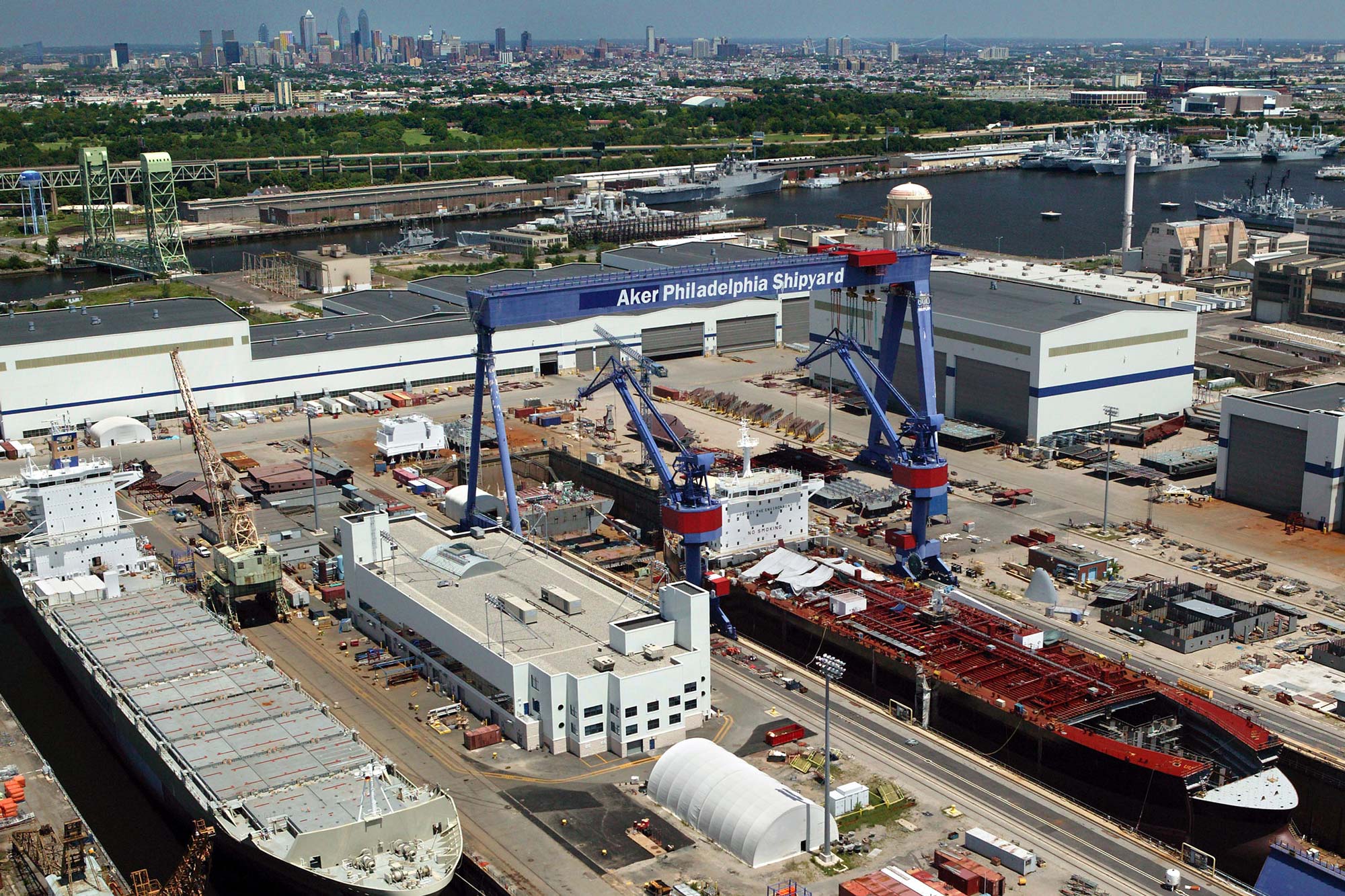
View of the Naval Shipyard when it was operated by Aker, a successor company to Kvaerner, from 2005 to 2015.
2005
Penn’s modified mRNA breakthrough helped turn biology into a programmable platform
In 2005, researchers Katalin Karikó and Drew Weissman at the University of Pennsylvania made a discovery that helped transform modern medicine. They found that modifying nucleosides in synthetic messenger RNA (mRNA) prevents the immune system from attacking it. Earlier attempts to use mRNA therapeutically failed because the body treated it like a viral threat. Their modification allowed mRNA to safely enter cells and produce proteins.
This breakthrough enabled the rapid development of mRNA vaccines, including the COVID-19 vaccines deployed worldwide in 2020. More broadly, it created a platform for designing medicines using genetic instructions rather than traditional chemical drugs.
The discovery helped establish Philadelphia as a global center for biotechnology and programmable medicine. Karikó and Weissman received the 2023 Nobel Prize in Physiology or Medicine for this work.

Stock Photo.

Stock Photo.
2015
Comcast made Philadelphia a proving ground for next-generation gigabit internet
In 2015, Comcast, headquartered in Philadelphia, demonstrated the world’s first live DOCSIS 3.1 gigabit-class modem on a customer network in the Philadelphia region. DOCSIS technology allows cable television infrastructure to deliver broadband internet. The DOCSIS 3.1 standard dramatically increased network capacity and speed, making gigabit internet possible using existing cable networks.
This development was significant because it showed high-speed broadband could be deployed widely without building entirely new infrastructure. Comcast engineers in Philadelphia helped lead the development and testing of the technology.
High-capacity broadband is essential to the Fourth Industrial Revolution, supporting cloud computing, telemedicine, AI, advanced manufacturing, and streaming services. Philadelphia played a key role in demonstrating how next-generation internet technology could scale to millions of users.
2019
Exyn showed how Philadelphia robotics could move from the lab into harsh industrial environments
In 2019, Exyn Technologies, a Philadelphia robotics company, introduced one of the first fully autonomous aerial robots for industrial environments. Founded in 2014 as a spinout from the University of Pennsylvania’s GRASP Laboratory, Exyn focuses on drones that can operate without GPS or human pilots.
Using LiDAR sensors, onboard computing, and advanced navigation algorithms, the drones can explore unknown environments and generate detailed 3D maps. In 2019, the company launched commercial systems used for underground mine mapping and inspection.
Autonomous robotics is a key technology of the Fourth Industrial Revolution, combining AI, sensors, and automation to improve safety and efficiency in industrial operations.
Exyn’s work demonstrates how Philadelphia robotics research moved from university laboratories into real-world industrial applications worldwide.
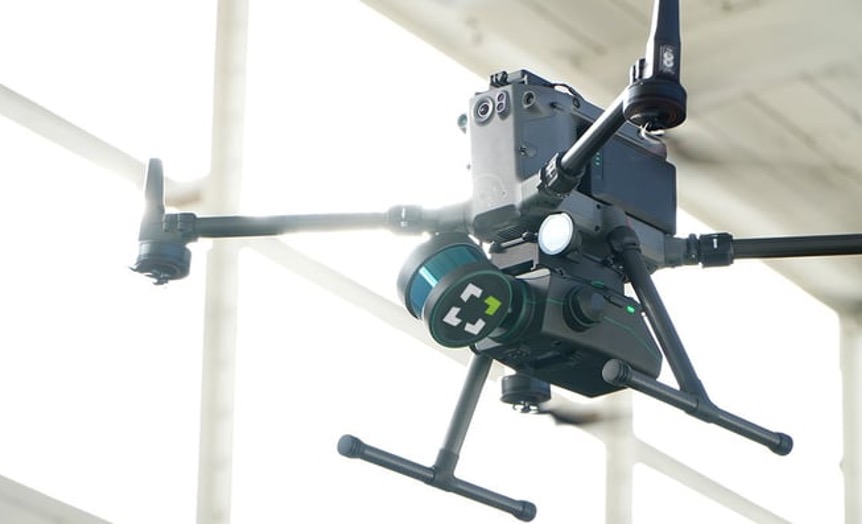
Courtesy of Exyn Technologies.
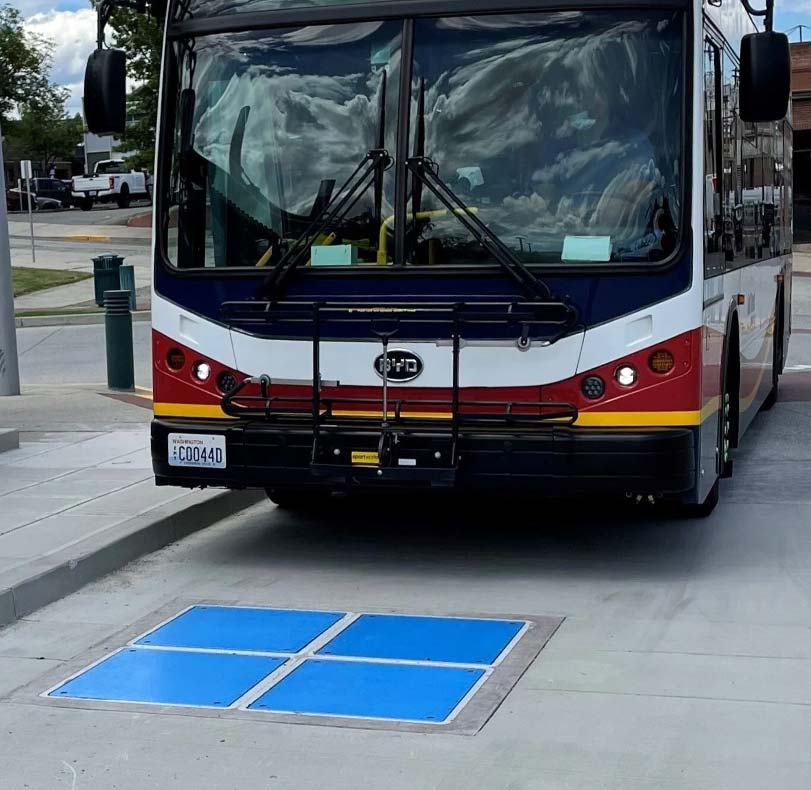
Courtesy of InductEV/Electreon.
2024
InductEV makes greater Philadelphia a wireless-EV-charging center
In 2023, InductEV now part of Electreon, headquartered in King of Prussia, opened the nation’s first research and development center dedicated to high-power wireless charging for electric vehicles and commercial fleets.
The 50,000-square-foot facility focuses on advancing wireless energy transfer technology that allows electric buses, trucks, and other vehicles to charge automatically without physical cables. Vehicles equipped with receiver plates can recharge simply by parking over embedded charging pads.
Wireless charging infrastructure is expected to play a key role in the electrification of transportation systems. The technology can reduce downtime for fleet vehicles and simplify large-scale EV adoption for public transit, logistics companies, and commercial operators.
As transportation becomes increasingly electrified and automated, innovations like wireless charging systems are considered part of the Fourth Industrial Revolution’s shift toward smart infrastructure and connected mobility systems.
2025
CHOP and Penn deliver the world’s first personalized CRISPR therapy
In 2025, researchers at the Children’s Hospital of Philadelphia (CHOP) and Penn Medicine treated the world’s first patient with a fully personalized CRISPR gene-editing therapy.
The treatment was developed for a baby born with carbamoyl phosphate synthetase 1 (CPS1) deficiency, a rare genetic disorder that prevents the body from properly processing ammonia. Researchers rapidly designed a customized gene-editing therapy targeting the patient’s specific mutation.
Using CRISPR-based base-editing technology delivered through lipid nanoparticles, the therapy corrected the genetic error inside the patient’s liver cells. The treatment was developed and administered in only a few months, demonstrating the potential for rapidly tailored genetic medicine.
This breakthrough represents a major milestone in precision medicine, showing that therapies can be designed specifically for individual patients rather than mass-produced for broad populations.
For the Fourth Industrial Revolution, personalized gene editing highlights how biotechnology, genomics, and advanced manufacturing are converging to transform healthcare.
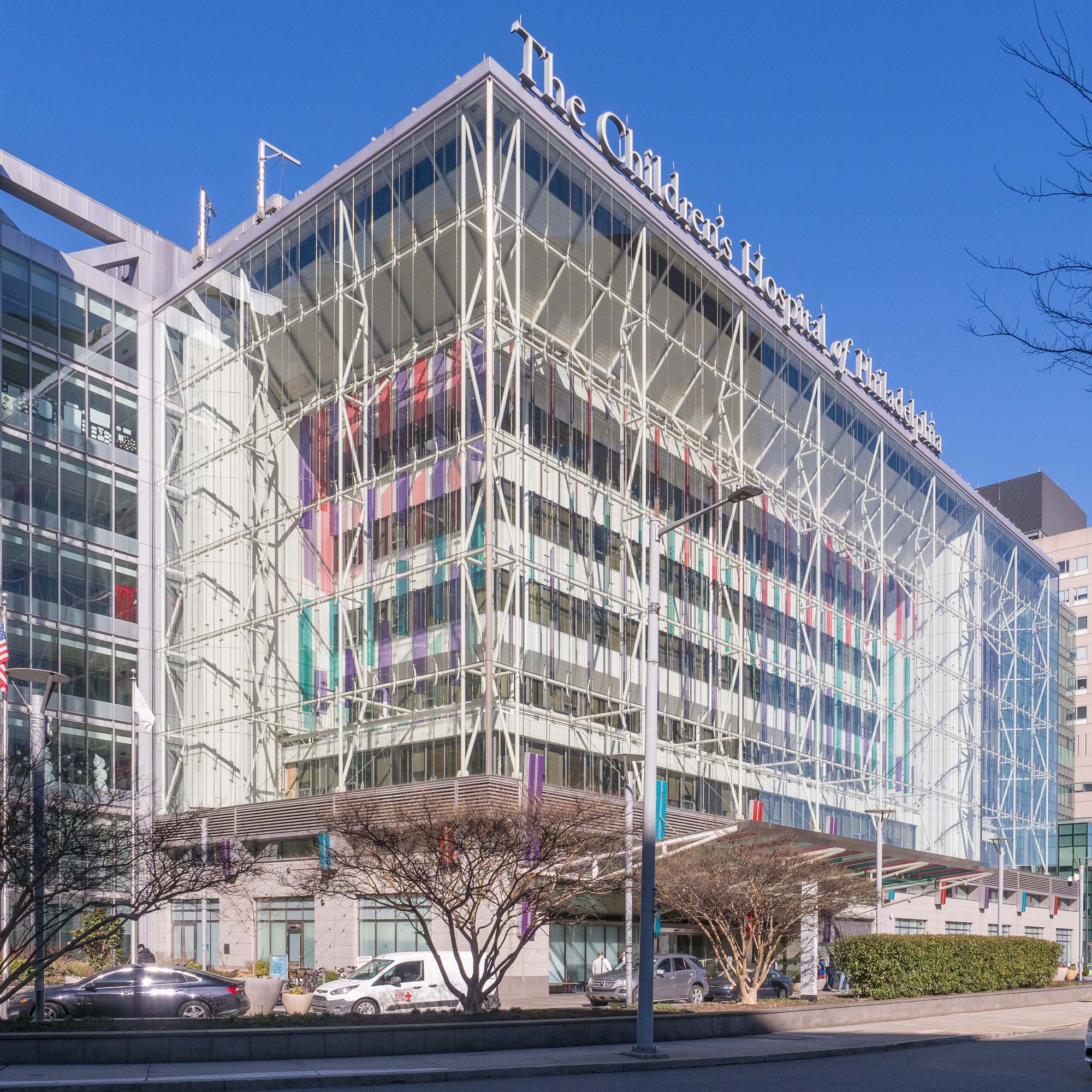
Photo by Ajay Suresh.